
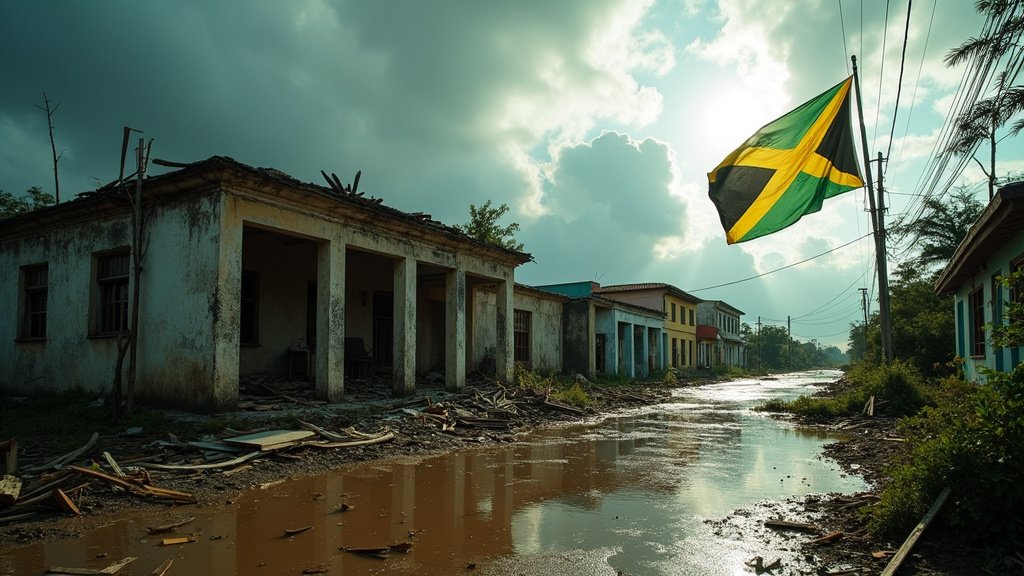
Jamaica is grappling with the aftermath of Hurricane Melissa, a historic Category 5 storm that made landfall on October 28, 2025, unleashing catastrophic winds, torrential rain, and devastating storm surges. The hurricane, one of the most powerful Atlantic storms on record, has caused an estimated $8.8 billion in physical damage across the island nation, equivalent to 41% of its 2024 GDP, marking it as the costliest natural disaster in Jamaica’s history.
The Fury of a Record-Breaking Storm
Hurricane Melissa rapidly intensified into a Category 5 behemoth, with sustained winds reaching 185 mph (295 kph) and gusts recorded as high as 200-252 mph (322-406 kph). Scientists attribute this extreme intensification to abnormally warm ocean waters, a phenomenon increasingly linked to human-caused climate change, which is making such powerful storms more common. The storm’s immense power was such that seismographs hundreds of miles away registered its passage.
Forecasters warned of catastrophic flash flooding and numerous landslides, with some areas in Jamaica receiving up to 40 inches of rain, far exceeding typical annual rainfall totals. The storm’s slow movement over the island exacerbated the destruction, leading to a prolonged period of life-threatening conditions.
Devastation Across Jamaica
The direct hit from Hurricane Melissa left a trail of unparalleled destruction across western and southern Jamaica. The parishes of St. Elizabeth, Westmoreland, Hanover, Manchester, St. James, Trelawny, and St. Ann bore the brunt of the storm’s ferocity. Entire towns were decimated, with reports indicating that up to 90% of buildings in some areas were impacted. Residential buildings accounted for the largest share of damage at 41%, followed by infrastructure at 33%, non-residential buildings at 21%, and agriculture at 5%.
Tragically, 45 confirmed deaths have been attributed to the hurricane in Jamaica, with an additional 15 individuals still missing. Thousands were left homeless, and widespread power outages and communication disruptions persisted for weeks across the island, significantly hindering rescue and recovery efforts. Over 4.8 million tonnes of debris, including rubble, vegetation, and household waste, now block roads, schools, and markets, underscoring the immense task of clearing and rebuilding.
Wider Caribbean Impact and Humanitarian Crises
Beyond Jamaica, Hurricane Melissa inflicted significant damage and loss of life across the Caribbean. In Haiti, the storm’s torrential rains and flooding triggered landslides, resulting in at least 43 deaths and 13 missing persons, according to official reports. The hurricane compounded an already severe humanitarian crisis in Haiti, marked by poverty and widespread insecurity due to gang violence, leading to increased displacement and straining vital resources.
Cuba experienced landfall as a Category 3 hurricane, with considerable damage reported, including collapsed houses and widespread flooding. Thankfully, no fatalities were reported in Cuba. The Dominican Republic also suffered from heavy rainfall and landslides, with at least one death confirmed. Warnings and evacuations were also in effect for the Bahamas and Bermuda as the storm continued its path.
The Climate Change Link
Scientists have highlighted that the rapid intensification of Hurricane Melissa is a symptom of a warming planet. The unusually warm ocean temperatures in Melissa’s path, exacerbated by human-caused climate change, provided abundant energy for the storm, increasing its wind speeds by an estimated 7% and its rainfall intensity by 16%. This phenomenon underscores the increasing threat of super hurricanes to vulnerable regions like the Caribbean, where climate change is expected to make the strongest storms even more powerful.
The Long Road to Recovery
In the wake of the destruction, international bodies like the World Bank and the Inter-American Development Bank (IDB) are coordinating with the Jamaican government to support the massive recovery and reconstruction efforts. The United Nations and various humanitarian organizations have mobilized to provide essential aid, including food, water, and shelter, to affected populations across the region. The scale of the damage and the ongoing challenges, including debris removal and infrastructure repair, indicate that the recovery process will be long and arduous for the resilient communities of the Caribbean.