
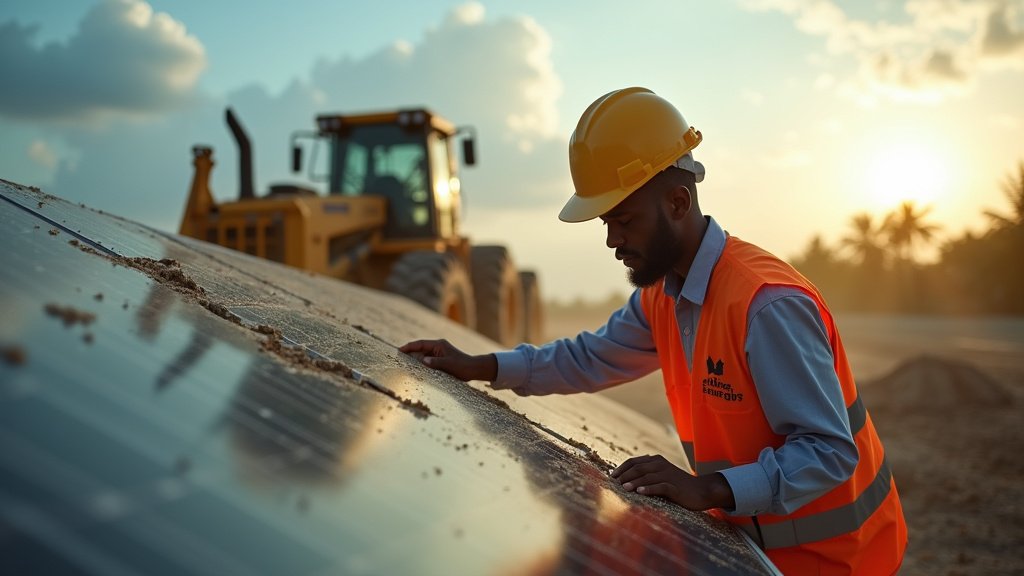
In the wake of Category 5 Hurricane Melissa’s devastating passage, InterEnergy Group has announced a comprehensive plan to rebuild Jamaica’s largest solar facility, the 52-megawatt Eight Rivers Solar Park (also known as Paradise Park) in Westmoreland. The powerful storm, which brought winds exceeding 185 miles per hour, inflicted catastrophic damage on the solar farm, highlighting the vulnerability of critical infrastructure in the face of increasingly severe climate events.
Hurricane Melissa’s Devastating Impact
Hurricane Melissa, one of the strongest storms to ever make landfall in Jamaica, caused widespread destruction across the island. Early reports indicated blackouts affecting nearly 80% of the country, with significant damage to transmission and distribution networks, particularly in central and western parishes. The Eight Rivers Solar Park, a key component of Jamaica’s renewable energy efforts, suffered “catastrophic damage” due to the extreme winds. This event underscores the broader challenges faced by island nations in the Caribbean, which are disproportionately affected by climate change and extreme weather. The total physical damage across Jamaica from Hurricane Melissa has been estimated at a record US$8.8 billion, equivalent to approximately 41% of the island’s 2024 GDP.
InterEnergy’s Commitment to Resilience and Recovery
InterEnergy Group, which acquired the solar park earlier this year, has reaffirmed its commitment to Jamaica’s energy future by initiating an immediate reconstruction plan. Rolando González Bunster, Chairman and Chief Executive Officer of InterEnergy Group, stated, “We will immediately begin rebuilding the Eight Rivers Solar Park, in a stronger, safer and more resilient way, reaffirming our commitment to the energy future of Jamaica and the Caribbean”. The company’s strategy goes beyond simply restoring capacity; it aims to enhance the park’s infrastructure to better withstand future severe climate events. This commitment reflects InterEnergy’s broader role as a private power pioneer in the region, contributing to the economic and social development of the communities where it operates.
Beyond the reconstruction of the solar park, InterEnergy has been actively involved in humanitarian efforts. Dr. Wayne McKenzie, Country Manager of InterEnergy Jamaica, noted the “strength of the human spirit” in the face of adversity, highlighting the company’s support for affected communities. This includes clearing access roads, organizing relief logistics, and distributing care packages.
Supporting Jamaica’s Energy Goals and Regional Solidarity
Jamaica has set ambitious targets for renewable energy integration, aiming for 20% of its energy mix to come from renewable sources by 2030 as part of its National Energy Policy. The Eight Rivers Solar Park, operational since 2019, has been a significant contributor, generating over 80 GWh annually and avoiding approximately 13,500 tons of CO₂ emissions. The damage to this facility represents a setback for these goals, but also an opportunity to rebuild with greater resilience.
In this challenging period, the Caribbean community has shown remarkable solidarity. Neighboring CARICOM countries, including Guyana, Antigua and Barbuda, Grenada, and Barbados, have pledged financial and material support to aid Jamaica’s recovery. This regional cooperation is vital for island nations facing shared vulnerabilities to natural disasters and climate change. The resilience of the Jamaican people, a testament to their culture, has been widely noted by regional leaders. This unified response is crucial for rebuilding not just infrastructure, but also hope.
Despite the damage to its renewable assets, InterEnergy’s main thermal power plants in Jamaica remain operational, continuing to supply power to the national grid. The company is also assessing its wind farm in St. Elizabeth for a safe resumption of operations.
Looking Ahead
The rebuilding of the Eight Rivers Solar Park is more than just an infrastructure project; it is a symbol of resilience and a commitment to a sustainable energy future for Jamaica and the wider Caribbean region. This incident serves as a stark reminder of the escalating threat of climate change and the critical need for enhanced infrastructure resilience across the Caribbean. The ongoing efforts by InterEnergy, supported by regional partners, aim to not only restore power but to ensure a more robust and sustainable energy supply for generations to come. This significant news highlights the intricate balance between development, climate impact, and the collective will to recover and rebuild stronger.