
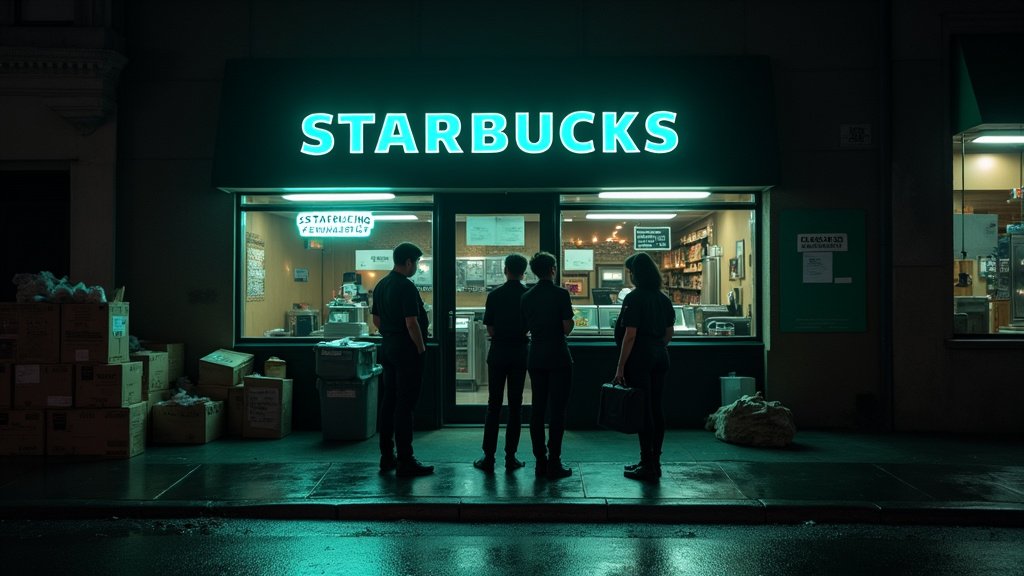
Starbucks has abruptly shuttered 54 locations across New York City in a move described by many as “chaotic downsizing,” leaving employees, landlords, and customers reeling from the sudden closures. This dramatic action, executed with little to no advance warning, is part of a larger national restructuring plan by the coffee giant to close over 400 underperforming stores and eliminate approximately 900 corporate roles. The news broke on September 25, 2025, as employees discovered their workplaces were unexpectedly dark, with many reporting they learned about the closures through news reports or signs posted overnight.
A Sweeping National Strategy Hits New York
The New York City closures represent a significant portion of Starbucks’ nationwide effort to re-evaluate its retail footprint. CEO Brian Niccol stated that the company had identified coffeehouses that were either unable to create the “physical environment our customers and partners expect” or lacked a viable path to financial performance. This strategic shift, dubbed “Back to Starbucks,” aims to revitalize the brand by focusing resources on more profitable and experience-driven locations, even as it means shrinking the overall store count by about 1% in North America.
Employees Left in the Dark Amid Legal Scrutiny
The suddenness of the closures has drawn sharp criticism and ignited legal battles. New York City’s Department of Consumer and Worker Protection (DCWP) has flagged potential violations of the city’s Fair Workweek Law, which mandates that employees affected by store closures must be offered comparable positions in the same borough. The DCWP sent a warning letter to Starbucks, demanding an explanation for how the company intends to comply with these labor obligations. While Starbucks has stated its commitment to offering severance packages and exploring transfer opportunities for affected partners, the lack of prior notification has caused significant distress and uncertainty for many.
Unionization Efforts and Mounting Tensions
The closures have also intensified scrutiny regarding Starbucks’ relationship with its growing unionized workforce. A substantial number of the shuttered New York City stores were unionized under Starbucks Workers United. While Starbucks maintains that union status was not a deciding factor in the closures, union organizers and employees have voiced suspicions of retaliation, pointing to past instances of store closures following unionization votes. These recent events have fueled ongoing labor disputes, with Starbucks Workers United actively protesting the company’s labor practices and lack of progress in contract negotiations, calling for better pay, improved staffing, and resolution of unfair labor practice charges.
Broader Economic Ripples in the Urban Landscape
The “Starbucks Effect,” where the presence of a store signaled a neighborhood’s economic health and desirability, may be giving way to a “Starbucks Exit Effect.” Real estate experts suggest that the closure of multiple locations in dense urban areas could negatively impact property values and signal a weakening of local demand and walkability. Concurrently, these high-profile closures create voids in commercial corridors, potentially offering opportunities for independent coffee shops and other food businesses to capture displaced customers.
A Changing Coffee Culture
The widespread store closures and the company’s strategic pivot signal a broader recalibration within the coffee giant and the urban retail sector. As Starbucks streamlines its operations, focusing on fewer, more curated locations, the impact on its workforce, community relationships, and the broader retail ecosystem in New York City remains a significant piece of news shaping the city’s evolving landscape. The company’s “Back to Starbucks” strategy is a gamble to enhance financial performance and customer experience, but the abruptness of these closures underscores the challenges and controversies inherent in such large-scale corporate transformations, prompting discussions about the future of retail and labor relations.