
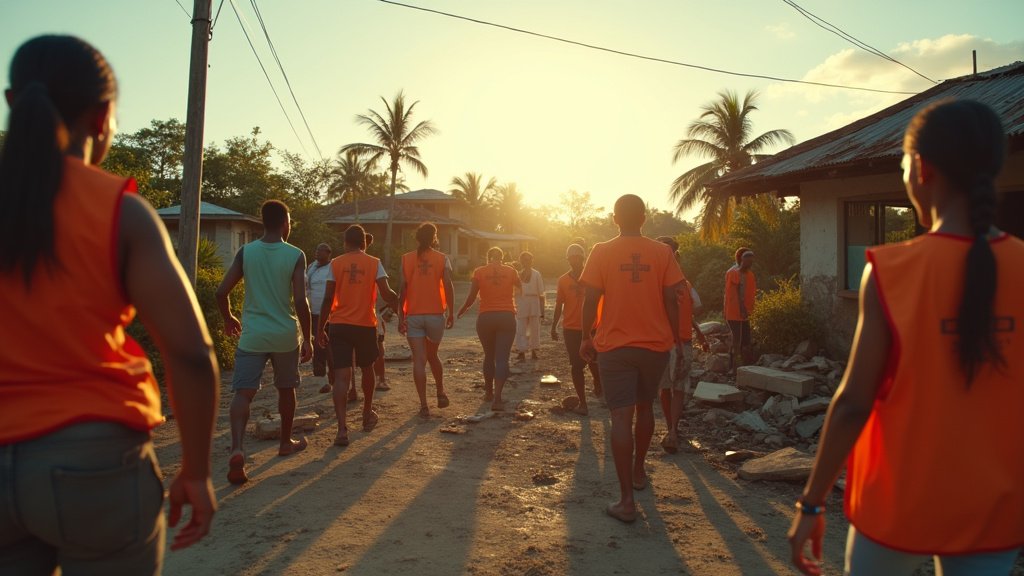
Kingston, Jamaica – In the wake of the devastating Hurricane Melissa, Jamaica is spearheading a comprehensive national recovery effort, drawing on robust support from regional and international partners. The Category 5 storm, which made landfall on October 28 with catastrophic winds of 185 mph, inflicted widespread destruction across the island, causing immense damage to infrastructure, displacing tens of thousands, and resulting in significant loss of life. The government, in conjunction with national and global entities, has launched a multi-faceted strategy to restore essential services, deliver immediate relief, and rebuild communities throughout the Caribbean nation.
Widespread Devastation and Initial Response
Hurricane Melissa’s fury left a profound impact on Jamaica, with particular devastation concentrated in its western parishes. The storm triggered catastrophic winds, extensive flooding, landslides, and severe structural damage to buildings and infrastructure. A critical blow was dealt to the Black River Hospital, a vital medical facility that suffered such severe damage that it required temporary decommissioning, necessitating the establishment of a field hospital. Across the island, seven hospitals situated in the southern and western belts reported catastrophic damage to their roofs and overall infrastructure. Beyond healthcare, the storm crippled the power grid, leaving over 70% of Jamaica’s electricity customers without power, and severely disrupted communication networks. Approximately 600,000 individuals were affected, with tens of thousands of households displaced. Many communities remained isolated for extended periods due to the destruction of transportation routes. The economic repercussions are staggering, with preliminary estimates placing the damage between $6 and $7 billion USD. Prime Minister Andrew Holness has characterized the scale of destruction as unprecedented, surpassing the impact of previous major hurricanes like Gilbert and Ivan.
The Office of Disaster Preparedness and Emergency Management (ODPEM) is at the forefront of coordinating the national response, focusing on vital areas such as early warning systems, immediate emergency response, and sustained relief and recovery operations. Complementing these efforts, the Ministry of Labour and Social Security is leading the crucial tasks of damage assessment, shelter management, and the coordination of welfare activities, working in close collaboration with ODPEM.
Mobilizing Regional and International Aid
Jamaica has swiftly garnered substantial regional and international backing to facilitate its recovery. The United States government has emerged as a leading contributor, providing considerable financial assistance. An initial sum of $11 million was followed by further aid, elevating the total emergency, life-saving assistance for Jamaica to over $22 million by mid-November, in addition to broader aid packages extended to the wider region. This vital funding is directed towards crucial recovery tasks, including debris removal, restoring access to impassable areas, and providing essential resources such as shelter, emergency healthcare, sanitation, and food supplies. The deployment of specialized U.S. government helicopters and urban search-and-rescue teams was instrumental in the immediate aftermath of the disaster.
CAF (Development Bank of Latin America and the Caribbean) has also been proactive in mobilizing emergency aid, extending an emergency grant of US$670,000 to Jamaica. Furthermore, CAF has facilitated bilateral assistance from El Salvador, which includes the provision of 37 tons of humanitarian supplies and the deployment of over 300 emergency personnel to the island. On a larger scale, CAF, in partnership with the Inter-American Development Bank (IDB) and the Caribbean Development Bank (CDB), has launched the Caribbean Multi-Guarantor Debt-for-Resilience Joint Initiative. This innovative program is designed to enhance disaster preparedness and alleviate debt burdens across the Caribbean, thereby enabling countries to invest more effectively in resilience-building measures.
The International Federation of Red Cross and Red Crescent Societies (IFRC) has dispatched substantial humanitarian aid, encompassing shelter kits, solar lamps, and tarpaulins, to aid affected communities. The United Nations Office for Disaster Risk Reduction (UNDRR) has joined forces with CAF to introduce the first resilience bond for Latin America and the Caribbean, a financial mechanism aimed at funding projects that reduce vulnerability to natural hazards.
Community-Led Recovery and Entertainment’s Role
The resilience of the Jamaican spirit is powerfully demonstrated by the vigorous mobilization efforts emanating from the diaspora and local community leaders. Organizations such as the American Friends of Jamaica (AFJ) have spearheaded significant fundraising campaigns, including a $1 million matching fund, to bolster relief and recovery initiatives. The NCB Foundation has also collaborated with the AFJ to amplify the impact of donations.
The entertainment sector has played a crucial role in rallying support, with a series of benefit concerts, including “Jamaica Strong” and “I Love Jamaica,” featuring renowned artists such as Sean Paul, Shaggy, Ky-Mani Marley, and Tessanne Chin. These events are strategically designed to raise substantial funds, with organizers aiming to collect at least $1 million from the “Jamaica Strong” concert alone. The proceeds are earmarked for the reconstruction of homes, schools, and the restoration of livelihoods. Grammy-winning artist Beenie Man, through his foundation, has been actively engaged on the ground, participating in road clearing, distributing essential supplies, and visiting hospitals in western Jamaica.
Path Forward: Rebuilding and Resilience
The immediate priorities for Jamaica involve the restoration of critical infrastructure, the re-establishment of essential services such as power and water, and providing comprehensive support for displaced families. The Jamaican government, through its Ministry of Health and Wellness, is actively establishing field hospitals and deploying primary care facilities to enhance healthcare capacity. Long-term recovery strategies are focused not only on physical reconstruction but also on fortifying the nation’s disaster preparedness and resilience against future climate-related events. Jamaica has a well-established framework for disaster financing, utilizing financial instruments like catastrophe bonds and credit lines to expedite recovery, although the immense scale of damage caused by Hurricane Melissa presents a considerable challenge. The collective endeavors, spanning government agencies, international organizations, the vibrant diaspora, and local communities, highlight a unified dedication to navigating this crisis and emerging stronger. The ongoing news from the Caribbean reflects a nation resolute in its commitment to recovery and reconstruction.