
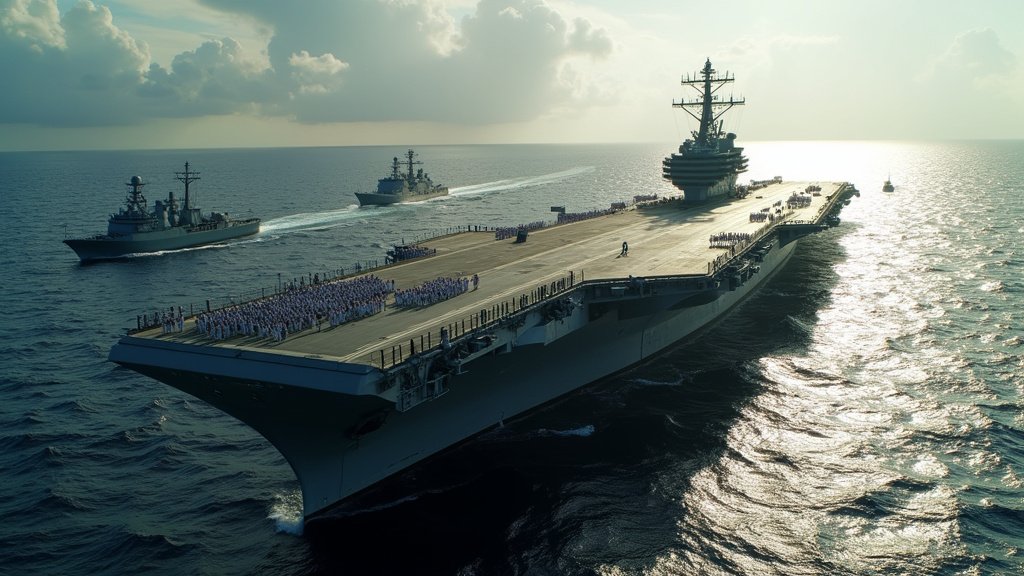
The Caribbean Sea has become a significant geopolitical flashpoint as the United States dramatically escalates its military presence, deploying a formidable naval armada and thousands of troops. This assertive posture, officially framed as a counter-narcotics operation, has prompted Venezuela to conduct extensive military exercises and prepare for potential land strikes, creating a climate of heightened tension and regional alarm.
A Significant U.S. Military Commitment in the Caribbean
In recent weeks, the United States has amassed one of its largest naval concentrations in the Caribbean in decades. The centerpiece of this deployment is the USS Gerald R. Ford, the U.S. Navy’s newest and most advanced supercarrier, accompanied by its strike group, including fighter jets and guided-missile destroyers. This formidable force is augmented by the USS Iwo Jima Amphibious Ready Group, carrying over 2,200 Marines, alongside additional warships and a nuclear-powered submarine. In total, nearly a dozen U.S. Navy ships and approximately 12,000 to 15,000 sailors and Marines are operating in the region, under an operation dubbed “Operation Southern Spear”.
While the U.S. administration, including Secretary of State Marco Rubio, asserts that the primary objective is to combat drug trafficking and “narco-terrorism” flowing into the United States, the scale of the deployment and the aggressive tactics employed have raised broader questions about the administration’s strategic intent. The U.S. has conducted over 20 strikes on suspected drug-running boats since September, resulting in significant casualties, though evidence publicly linking those killed to drug cartels has been sparse. President Trump has not ruled out striking land targets within Venezuela, including ports and airstrips, signaling a potential expansion of the military campaign.
Venezuela’s Response: Defense and Determination
In response to what Venezuelan officials describe as a “threatening and vulgar deployment” of U.S. ships, Caracas has initiated its own military maneuvers. Exercises like “Caribe Soberano 200” have been conducted along Venezuela’s Caribbean coast, involving land, air, and sea forces to bolster defensive capabilities and national sovereignty. Interior Minister Diosdado Cabello, while downplaying immediate threats, has urged the population to remain vigilant, accusing the U.S. of a “ferocious campaign” and a “siege” aimed at regime change. Venezuela denies allegations of leading drug cartels and views the U.S. military actions as a provocation designed to destabilize the government and seize its resources. The nation has also mobilized its reserves, with reports indicating hundreds of thousands of troops and militia members on alert.
Broader Geopolitical Currents and Regional Repercussions
The intensified U.S. focus on the Caribbean and Venezuela is occurring within a broader context of shifting U.S. foreign policy in the Western Hemisphere. The Trump administration’s “America First” agenda has led to increased pressure on regional governments. This includes imposing sanctions on Colombian President Gustavo Petro, who has been criticized by U.S. officials like Secretary of State Marco Rubio for his approach to drug interdiction and has accused the U.S. of “extrajudicial executions” in its maritime strikes. Additionally, trade disputes involving U.S. tariffs on Brazilian goods have persisted, though recent diplomatic engagements between President Trump and Brazilian President Luiz Inácio Lula da Silva have led to some tariff reductions.
These geopolitical maneuvers are being watched closely by international actors. China, for instance, has condemned the U.S. military buildup in the Caribbean, while strengthening its ties with Venezuela through financial aid and strategic partnerships, signaling a growing multipolar dynamic. The U.S. military’s actions have also drawn skepticism from some European allies and regional bodies like CELAC, who question the legality and justification for the strikes and fear a destabilization of the region.
An Uncertain Horizon for the Caribbean
The current standoff presents a complex tapestry of national security concerns, political posturing, and potential humanitarian implications. While the U.S. administration insists its actions are a necessary defense against drug flows, critics and regional observers point to the significant loss of life and the potential for a wider conflict. The heightened military presence and retaliatory measures have injected a potent mix of anxiety and anticipation across the Caribbean. The region, known for its vibrant culture and lively music scene, now finds itself at the epicenter of a geopolitical drama with potentially far-reaching consequences. The news of these developments travels rapidly, shaping perceptions and fueling uncertainty. As both sides reinforce their positions, the international community watches, aware that the delicate balance of power in the Americas could be irrevocably altered by the unfolding events in the Caribbean Sea.