
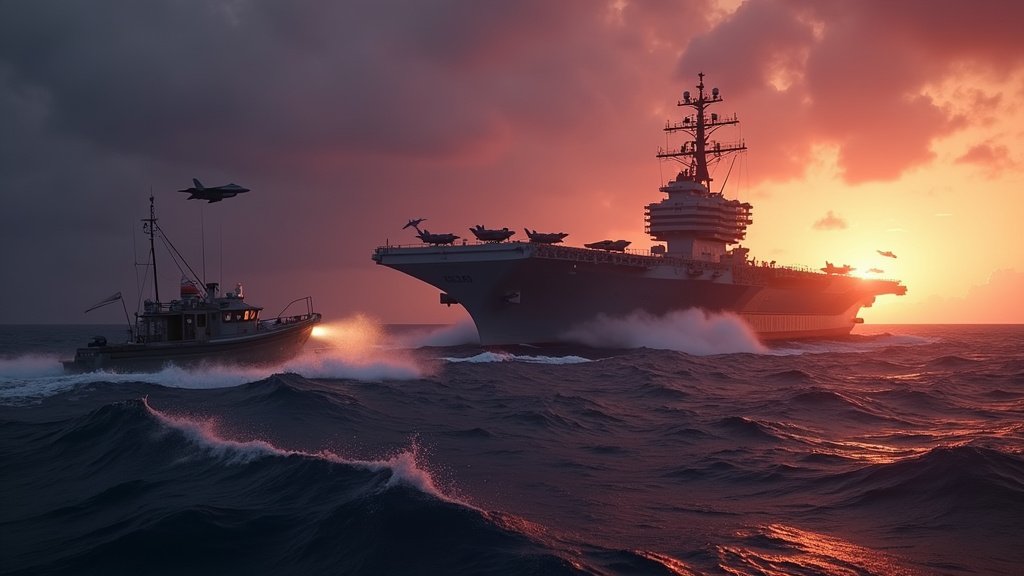
Washington’s intensified military campaign against alleged drug trafficking in the Caribbean and eastern Pacific has resulted in a new strike that killed three individuals, pushing the cumulative death toll from the controversial operations to at least 83. The latest incident underscores the escalating, yet increasingly scrutinized, efforts by the U.S. military under the Trump administration to interdict narcotics flowing towards American shores.
Latest Strike Adds to Mounting Fatality Count
Pentagon chief Pete Hegseth confirmed that U.S. forces conducted a strike on a vessel on September 15, 2025, which claimed the lives of three individuals. Hegseth asserted that the targeted boat was linked to a U.S.-designated terrorist organization and was involved in illicit narcotics smuggling along a known trafficking route. This operation is part of a broader offensive that began in early September 2025, involving airstrikes against suspected drug-smuggling vessels.
Operation Southern Spear: A Campaign of Lethal Force
This wave of military action, formalized as “Operation Southern Spear,” was initiated by President Donald Trump to combat what he terms “narco-terrorists” and halt the flow of deadly drugs into the United States. The campaign, led by Joint Task Force Southern Spear under U.S. Southern Command, has involved the deployment of significant naval assets, including the USS Gerald R. Ford Carrier Strike Group, alongside advanced technology such as robotic and autonomous systems. Since the operation’s commencement, the U.S. military has conducted at least 21 strikes, destroying over 20 vessels and resulting in a substantial number of fatalities.
Questions of Legitimacy and Civilian Casualties
While the U.S. administration contends that all targeted vessels were operated by cartels or designated terrorist groups, critics and international observers have raised serious doubts about the evidence and the legality of the strikes. Reports suggest that many of the deceased may have been civilians, including fishermen, rather than hardened criminals. Families of those killed have questioned the U.S. claims, and some reports indicate that the targeted boats were stationary or turning away at the time of the attacks. The U.S. has not publicly provided evidence to substantiate its allegations regarding the targeted vessels and their occupants.
International Allies Express Alarm
The controversial nature of the strikes has led to significant international backlash. The United Kingdom has suspended intelligence sharing with the U.S. concerning suspected drug vessels, citing concerns that such information could facilitate operations they deem unlawful. Colombia has also halted intelligence sharing, with President Gustavo Petro stating that the fight against drugs must be subordinated to the human rights of Caribbean people. Canada has similarly informed Washington that it does not want its intelligence used to support lethal strikes. The UN High Commissioner for Human Rights has declared the operations violate international human rights law, characterizing them as “extrajudicial killings”.
Shifting Strategy Amidst Regional Tensions
The intensified military approach marks a departure from traditional law enforcement interdictions, which President Trump has dismissed as ineffective. The deployment of substantial military force, including F-35 stealth jets and bombers, into the Caribbean region has also heightened tensions, particularly with Venezuela, whose government has accused the U.S. of using the anti-drug campaign as a pretext for regime change. The U.S. Department of War has notified Congress that the United States is engaged in an “armed conflict” with drug cartels, a classification that expands the legal basis for lethal action. The use of advanced technology in these operations is a critical component, with U.S. Customs and Border Protection also leveraging sophisticated tools for interdictions.
The ongoing military operations in the Caribbean and eastern Pacific continue to be a focal point of international news, sparking debate over counter-narcotics strategy, international law, and the U.S. role in regional security.