
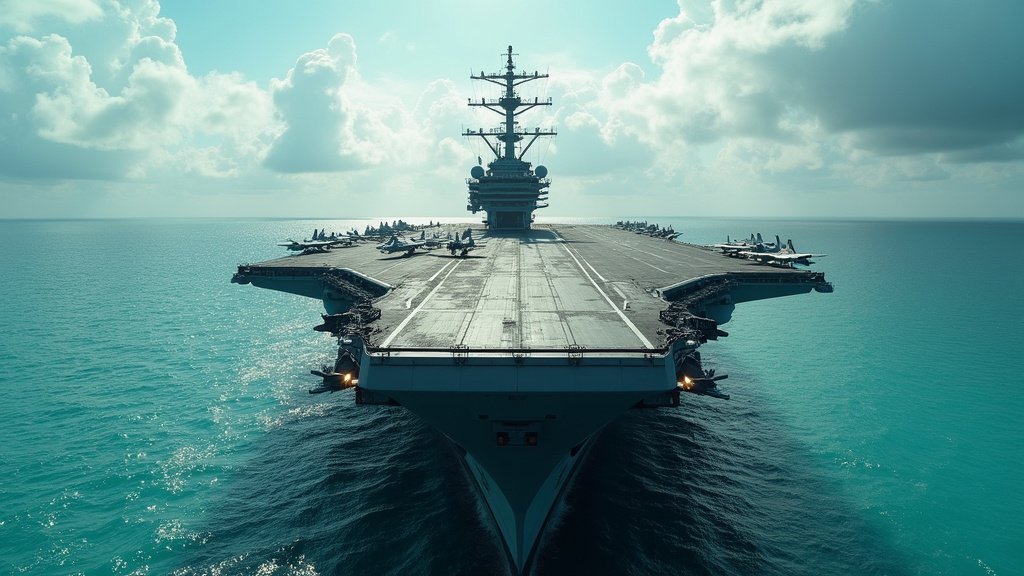
The USS Gerald R. Ford Carrier Strike Group, featuring the world’s most advanced aircraft carrier, has entered the Caribbean Sea, marking a significant escalation in United States military operations in the region. The deployment is a cornerstone of the newly unveiled “Operation Southern Spear,” a sweeping initiative aimed at dismantling transnational criminal organizations and countering narco-terrorism, according to official statements.
Operation Southern Spear: A New Offensive in the Caribbean
Officially announced by Secretary of War Pete Hegseth on November 13, 2025, Operation Southern Spear is directed by President Trump and represents a substantial commitment to securing the Western Hemisphere and the U.S. homeland. The operation’s stated objective is to disrupt drug trafficking networks and combat criminal elements that threaten regional stability. The U.S. Southern Command (SOUTHCOM) is overseeing the joint task force established for this mission, emphasizing a proactive stance against threats that exploit shared maritime domains.
Unprecedented Naval Presence Deploys to Caribbean
The arrival of the USS Gerald R. Ford (CVN-78) on November 16, 2025, signifies one of the largest U.S. military deployments to the Caribbean in decades. This formidable force comprises thousands of sailors and Marines aboard nearly a dozen warships, including the Ford’s carrier strike group, which features fighter jet squadrons and guided-missile destroyers. The strike group joins other naval assets already present in the region, such as the USS Iwo Jima Amphibious Ready Group and the 22nd Marine Expeditionary Unit, underscoring the comprehensive nature of the operation. The presence of advanced technology aboard the Ford, including state-of-the-art radar systems and specialized launch capabilities, enhances its operational flexibility.
Heightened Tensions and Geopolitical Undertones
The significant U.S. military buildup has occurred amidst escalating tensions with Venezuela. President Nicolás Maduro has accused the United States of using counter-narcotics operations as a pretext for regime change and to seize Venezuela’s vast oil resources. While U.S. officials maintain the deployment is focused on drug interdiction and national security, critics and regional observers suggest broader geopolitical ambitions, potentially including pressure on the Venezuelan government. The operation, framed as a fight against “narco-terrorism,” has been characterized by some as a return to “gunboat diplomacy”.
Controversial Strikes and Lack of Evidence
Recent months have seen an increase in U.S. military actions, with reports indicating approximately 20 to 21 strikes against suspected drug-trafficking vessels in international waters since September. These operations have reportedly resulted in at least 76 to 83 deaths. However, the U.S. administration has not presented concrete evidence to substantiate claims that the targeted vessels were indeed involved in narcotics trafficking, leading to concerns about the legality and justification of these lethal engagements.
Technological Superiority and Future Capabilities
The USS Gerald R. Ford represents a leap forward in naval technology. It is equipped with cutting-edge systems such as the Electromagnetic Aircraft Launch System (EMALS) and Advanced Arresting Gear (AAG), which allow for a higher sortie generation rate compared to previous carrier classes. The carrier’s design incorporates advanced radars and is built to accommodate future technological advancements, including directed energy weapons, showcasing a significant investment in naval power projection.
Operation Southern Spear and the presence of the USS Gerald R. Ford Carrier Strike Group highlight a robust and technologically advanced U.S. military posture in the Caribbean. While the official narrative emphasizes counter-narcotics and counter-terrorism, the scale of the deployment and the controversial nature of past operations continue to fuel debate and scrutiny regarding the broader strategic implications for the region and its complex geopolitical landscape. The news from the Caribbean signals a determined, albeit contested, phase in U.S. foreign policy.