
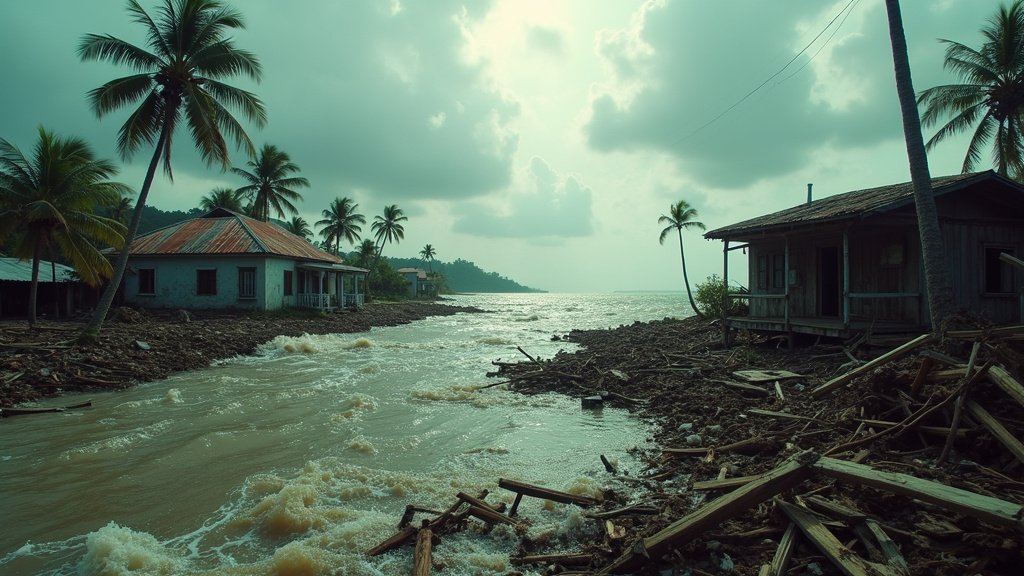
In a tumultuous period for international news, two major events have captured global attention: the catastrophic destruction wrought by Category 5 Hurricane Melissa across the Caribbean and a significant escalation of violence in the Middle East, threatening a fragile ceasefire in Gaza.
Hurricane Melissa’s Unprecedented Fury
On October 28, 2025, Hurricane Melissa made landfall in Jamaica as a devastating Category 5 storm, unleashing winds of up to 185 mph (295 kph) and causing widespread catastrophic damage. This marked the strongest hurricane on record to make landfall in Jamaica, leaving a trail of destruction that included demolished homes, flooded communities, and shattered infrastructure. The storm’s immense power was amplified by exceptionally warm ocean waters, a condition made significantly more likely by climate change.
Following its destructive path through Jamaica, Hurricane Melissa continued its trajectory, striking Cuba as a Category 3 storm. The broader Caribbean region, including Haiti, the Dominican Republic, the Bahamas, and Turks and Caicos Islands, also endured severe impacts, characterized by torrential rains, life-threatening storm surges, and extensive flooding.
The human toll has been immense, with initial reports indicating at least 96 fatalities attributed to the storm across the affected nations. Jamaica reported approximately 45 deaths, while Haiti tragically recorded over 43 fatalities, including children. Thousands of homes were destroyed or severely damaged, and an estimated 1.6 million people in Jamaica alone were affected, with nearly 2,500 remaining in shelters weeks later. The economic impact is staggering, with preliminary estimates placing the physical damage in Jamaica at nearly $9 billion USD, equivalent to 41% of the country’s GDP, making it the costliest storm in the island’s history.
Gaza Ceasefire Tested Amid Renewed Israeli Strikes
Simultaneously, the Middle East has seen a dangerous escalation of conflict, casting a shadow over the U.S.-brokered ceasefire between Israel and Hamas. Prime Minister Benjamin Netanyahu ordered “powerful strikes” in Gaza on October 28, 2025, alleging that Hamas had violated the truce. Israel claimed that its forces came under fire from Palestinian militants, a charge Hamas vehemently denied.
The tensions were further heightened by incidents involving the return of hostage remains. Israel stated that Hamas’s actions related to the handover of a hostage’s remains constituted a clear violation of the agreement, leading to Hamas announcing a delay in the transfer. The recovery and exchange of deceased hostages had been a critical, albeit slow, component of the ceasefire negotiations, with the full return of all remains being a key precursor to further phases of the deal.
These alleged violations triggered a wave of Israeli airstrikes across Gaza. In the period of late November 2025, strikes killed dozens of Palestinians. Reports from hospital officials indicated that over a 12-hour period, 33 people were killed, including women and children, in attacks targeting both residential buildings and tents sheltering displaced persons in Gaza City and Khan Younis. These attacks have been described as some of the deadliest since the ceasefire took effect last month. Hamas condemned the strikes as a “shocking massacre” and a “dangerous escalation,” urging international mediators, including the United States, Qatar, and Turkey, to intervene and halt what it termed Israel’s “war of extermination”.
A World Facing Dual Crises
As relief efforts begin in the Caribbean and the human cost of Hurricane Melissa continues to be tallied, the renewed hostilities in Gaza underscore the persistent fragility of peace in the region. The concurrent crises highlight a world grappling with severe natural disasters exacerbated by climate change and entrenched geopolitical conflicts, demanding urgent attention and coordinated global responses. The coming days will be critical in determining the trajectory of both the humanitarian recovery in the Caribbean and the stability of the ceasefire in Gaza. The ongoing news from these fronts underscores the interconnectedness of global challenges facing the world today.