
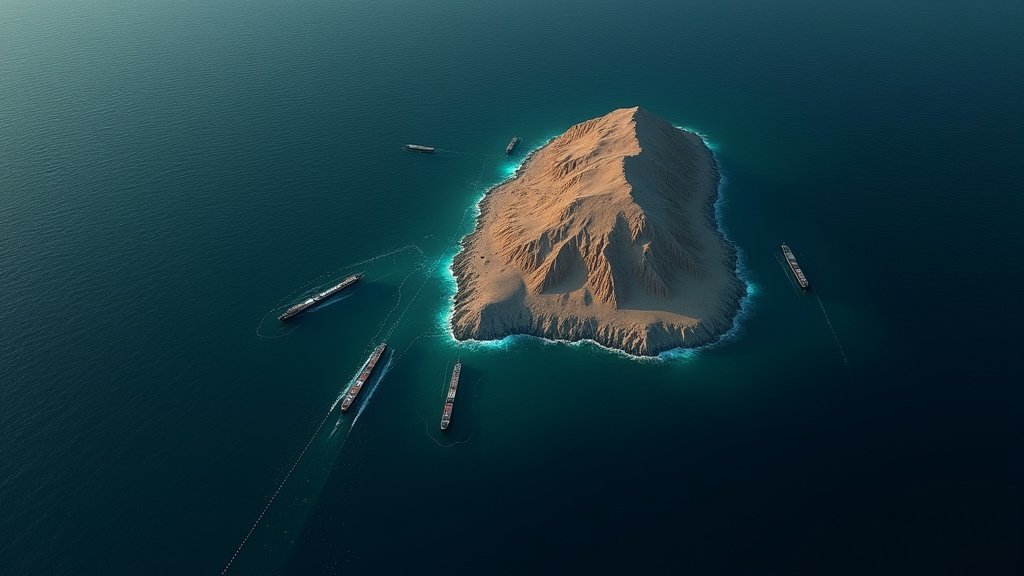
The Islamic Revolutionary Guard Corps (IRGC) Navy has officially implemented a new maritime transit protocol for the Strait of Hormuz, compelling all commercial vessels to adhere to specific, military-controlled navigation corridors. This directive, issued on April 9, 2026, requires incoming and outgoing ships to navigate narrow passages near Larak Island, effectively placing the transit of nearly one-fifth of the world’s global oil supply under the direct, tactical supervision of Iranian forces. The move arrives just days after the announcement of a fragile, two-week ceasefire between the United States and Iran, signaling that while open military combat may be paused, the struggle for dominance over this vital maritime chokepoint remains intensely active.
- Mandatory Rerouting: All vessels entering the Persian Gulf must now approach from the north of Larak Island, while those exiting must pass to the south, strictly deviating from traditional shipping lanes.
- Security Justification: Iranian officials cite the purported presence of anti-ship mines in the main transit channels as the primary reason for the shift, framing the measure as a navigation safety necessity.
- Direct Control: The IRGC has mandated that all vessels coordinate movements directly with their naval forces, formalizing a permission-based system that limits the autonomy of commercial shippers.
- Geopolitical Friction: The new restrictions persist despite a temporary ceasefire, raising immediate questions regarding the stability of the agreement and the freedom of international navigation.
The Strategic Lockdown of the Hormuz Chokepoint
Formalizing Tactical Control
The introduction of these designated transit corridors is widely viewed by regional analysts as a calculated maneuver to solidify control over the Strait of Hormuz. By forcing traffic into narrower, shallower, or more easily monitored waters near Larak Island—an area closer to the Iranian mainland—the IRGC is shifting the operational environment of the strait from a zone of international passage to one of highly scrutinized, permission-based transit. This isn’t merely a safety precaution; it is a tactical consolidation that allows the IRGC to verify cargo information, assess vessel traffic in real-time, and exert immediate leverage over any ship that does not comply with its rigid, newfound requirements.
The ‘Minefield’ Narrative
The justification provided by the IRGC—that the previous, wider transit channels are compromised by anti-ship mines—serves a dual purpose. On one hand, it provides a plausible legal and safety-oriented framework for forcing traffic into these monitored lanes. On the other, it creates an atmosphere of perpetual risk. By officially declaring the main shipping channels hazardous, Iran successfully deters unauthorized or ‘unfriendly’ vessels from straying from the prescribed paths. Even as the US and other global powers push for the ‘reopening’ of the strait, the Iranian military has effectively replaced the concept of open transit with a system of ‘guarded’ passage, where any vessel straying from the IRGC’s map risks being intercepted or challenged.
Ceasefire vs. Operational Reality
The timing of this announcement creates a complex dichotomy. While diplomats and international leaders celebrate the current two-week ceasefire, the reality on the water tells a different story. The IRGC has signaled that the strait will ‘never return to its previous status,’ suggesting that the current restrictions are not a temporary wartime measure but the foundation for a permanent, new maritime order. This creates a severe dilemma for the global shipping industry: follow the IRGC’s protocols and risk tacitly legitimizing their control, or refuse and face the threat of interception or further instability. For the global energy market, this means that even if hostilities are paused, the volatility of oil prices and shipping insurance premiums will remain elevated, as the strait remains under a ‘state of war’ operational regime.
FAQ: People Also Ask
Q: Are commercial ships still allowed to pass through the Strait of Hormuz?
A: Yes, but transit is now highly restricted. Ships must adhere to specific, IRGC-mandated routes near Larak Island and are required to coordinate movements directly with Iranian naval authorities.
Q: Why did the IRGC change the shipping routes?
A: Iran claims the changes are necessary to avoid potential collisions with anti-ship mines planted in the main shipping lanes during the recent conflict. They describe the rerouting as a safety measure for maritime traffic.
Q: Does the US-Iran ceasefire impact these navigation rules?
A: Despite the ceasefire, the IRGC has maintained these new protocols, indicating that they do not intend to restore the pre-war status quo of free navigation. Control over the strait remains a primary point of contention.
Q: What is the significance of Larak Island in this new plan?
A: Larak Island is being used as the primary navigational waypoint. By forcing ships to pass north or south of the island, the IRGC keeps traffic close to its coastal monitoring assets, enabling greater surveillance and easier interdiction capabilities.