
For decades, the sound of reggae in Boston has been inseparable from the life and labor of one man: Leroy Webb. As the proprietor of Taurus Records on Blue Hill Avenue in Mattapan, Webb has served as more than just a merchant of music; he has been an architect of the Caribbean diaspora’s cultural experience in Massachusetts. Arriving in Boston in 1973, armed with little more than a love for the genre and two prized vinyl albums, Webb helped transform a local landscape that was initially silent to the rhythms of dancehall, soca, and calypso. His journey from a listener standing outside a Jamaican record shop to the heartbeat of Boston’s Caribbean community reflects the broader, often untold history of immigrant influence on the American cultural tapestry.
Key Highlights
- Foundational Impact: Leroy Webb, owner of Taurus Records, has been pivotal in bringing Caribbean music to Boston since his arrival in 1973.
- Cultural Hub: Taurus Records, located in Mattapan, stands as a rare, surviving brick-and-mortar institution that serves as a community gathering space and cultural archive.
- The Promotional Catalyst: Beyond retail, Webb’s “Lion Productions” was instrumental in booking Caribbean artists and pushing reggae onto local radio airwaves, effectively creating a music ecosystem where none existed.
- A Half-Century Legacy: The store represents 50 years of persistence, maintaining relevance through shifts in technology, neighborhood demographics, and the global commercialization of reggae.
The Immutable Beat: A Legacy of Cultural Preservation
When Leroy Webb opened the doors to his first brick-and-mortar record store in the South End in 1981, the concept of a “reggae hub” in Boston was a revolutionary, if not uphill, battle. The city’s airwaves were largely devoid of the genre, and the specific distribution channels necessary to feed a growing Caribbean population simply did not exist. For those who had left the sun-drenched streets of the Caribbean to settle in the colder, more rigid environment of Massachusetts, the lack of music was not just an inconvenience—it was a severance from home. Webb’s establishment of Taurus Records did more than sell vinyl; it provided an auditory lifeline.
From Jamaica to the South End
Webb’s own narrative is inextricably linked to the post-1965 shifts in the Immigration and Nationality Act, which saw an influx of Caribbean immigrants into Massachusetts. Arriving in 1973, Webb brought with him the sonic memories of his youth in Jamaica. He recalls the feeling of emptiness that accompanied his early days in Boston, searching for a sound that defined his existence. This personal void became the motivation for his professional life. He didn’t just want to listen to music; he wanted to ensure that the music of his homeland was accessible to the community forming around him. His persistence in commuting to New York City to source records—often driving for hours to secure inventory—highlights the sheer labor required to build a cultural outpost in a city that had not yet learned to value it.
Pioneering a New Soundscape
Webb’s role expanded rapidly from a store owner to a promoter. Operating under names like Lion Productions, he navigated the complex, often restrictive landscape of 1970s and 80s Boston venue management. He printed flyers, distributed them in the streets, and aggressively courted local radio stations like WERS, essentially forcing the doors open for reggae to be played on air. He realized that for the music to thrive, it needed to be performed live. By bringing artists like Shabba Ranks and Coco Tea to Boston, he bridged the gap between the recorded product and the live experience, cementing his position as the primary curator of the region’s Caribbean aesthetic.
The Vinyl Sanctuary in a Digital World
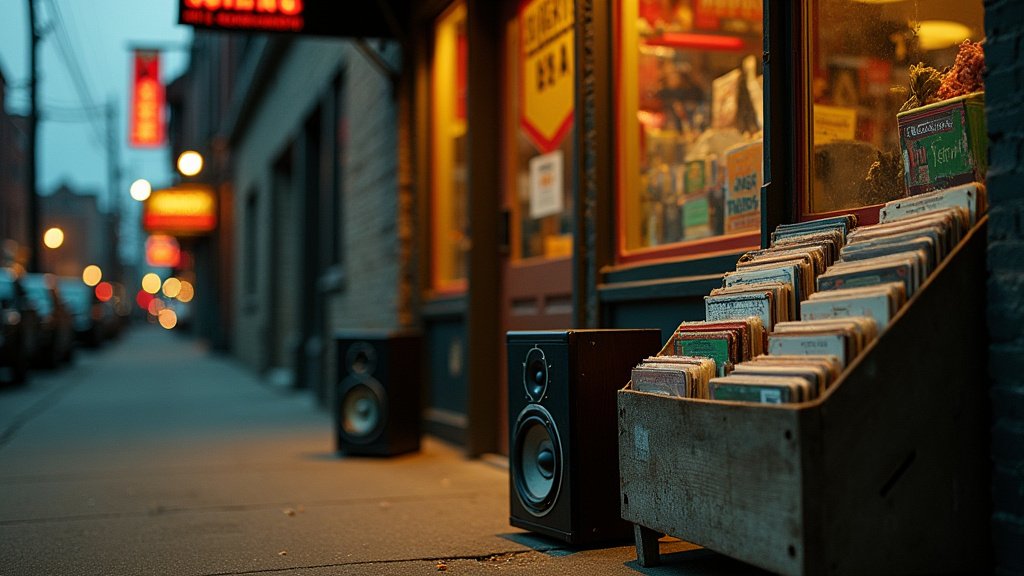
Today, Taurus Records remains a visual and sonic landmark on Blue Hill Avenue. With its iconic Rastafarian-colored exterior, the shop serves as a testament to the endurance of analog culture. In an era where music is consumed via algorithms and streaming platforms, Webb’s shop remains a physical sanctuary. When the weather is warm, the door remains open, allowing the music to spill onto the sidewalk—a classic, tactile form of advertising that has kept the store relevant for half a century. The store is not just about the transaction of goods; it is a repository of history where conversations about the music, the community, and the changing landscape of Boston take place daily.
Secondary Angles
1. The Intersection of Immigration and Music Discovery
This story illuminates the role of small businesses as cultural preservation sites. Immigrant communities often struggle with the dilution of culture upon assimilation. Taurus Records acted as an anchor, ensuring that the specific nuances of dancehall, soca, and calypso were preserved, allowing second and third-generation Caribbean-Americans to access their heritage through the same medium their parents did. It is a study in how music provides continuity during migration.
2. The Economics of Cultural Survival
Webb’s journey also provides a case study in the longevity of small, community-focused retail. While corporate chains struggle to maintain connection, Taurus Records succeeded by becoming “the place.” By diversifying into show promotion and radio advocacy, Webb utilized a multi-stream business model that allowed him to survive the lean years when physical media was dismissed as obsolete. It underscores that for independent businesses, cultural capital is often as valuable as liquid capital.
3. Urban Evolution and Gentrification
Looking at the history of Taurus Records is also looking at the history of Boston’s neighborhoods. From the South End to the evolution of Mattapan, the store has occupied spaces as they shifted from neglected pockets of the city to evolving cultural zones. The store’s stability acts as a stationary point from which one can observe the rapid displacement and transformation of Boston’s demographics over the last 50 years.
FAQ: People Also Ask
Q: What is the significance of Taurus Records in Boston’s music scene?
A: Taurus Records, founded by Leroy Webb, is the longest-running institution dedicated to reggae and Caribbean music in Boston. It has acted as a critical distribution center, promotion hub, and cultural archive for the Caribbean diaspora for over 50 years.
Q: How did Leroy Webb influence reggae radio in Boston?
A: In the 1970s and 80s, Webb actively promoted the genre by bringing vinyl directly to local college and independent radio stations, effectively lobbying for airplay and helping to break the genre into the Boston mainstream.
Q: Why is Taurus Records located in Mattapan?
A: The store’s location has shifted over the decades to follow and serve the needs of the Caribbean immigrant community, eventually landing on Blue Hill Avenue in Mattapan, a neighborhood with a large Caribbean population that finds a sense of home in the shop’s music and culture.
Q: Is Taurus Records still operating today?
A: Yes, the store continues to operate, maintaining its iconic status as a community landmark where the proprietor, Leroy Webb, still engages personally with the local community.