
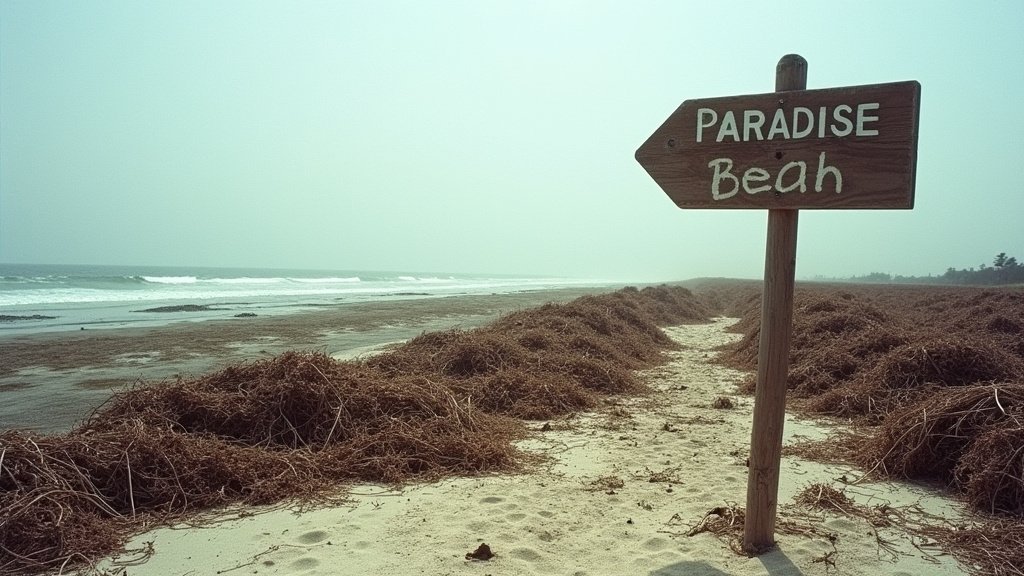
Record-breaking tons of sargassum seaweed are inundating the coastlines of Southeast Florida, the Florida Keys, and the wider Caribbean, creating an unprecedented ecological and economic challenge. This massive influx, driven by changing ocean currents and nutrient levels, is overwhelming natural ecosystems and posing significant threats to tourism and local marine life.
Key Highlights:
- Unprecedented sargassum accumulation impacting beaches and marine life.
- Significant economic strain on tourism-dependent regions.
- Urgent calls for coordinated regional and international response efforts.
- Potential long-term ecological consequences for coral reefs and seagrass beds.
The Sargassum Deluge: An Ecological and Economic Crisis
The arrival of vast quantities of sargassum seaweed along the shores of Southeast Florida, the Florida Keys, and numerous Caribbean islands marks a critical environmental event. This natural phenomenon, while occurring annually to some extent, has reached staggering proportions this year, overwhelming local authorities and communities. The sheer volume of the seaweed is not only choking pristine beaches but also creating a significant threat to the delicate marine ecosystems that depend on clear, healthy waters. The economic implications are dire, particularly for the vital tourism industry that serves as the lifeblood for many of these coastal regions. Beaches, once idyllic havens for tourists, are now blanketed in thick layers of decaying seaweed, emitting a pungent odor and deterring visitors.
Environmental Impacts Beyond the Shoreline
The ecological ramifications extend far beyond the visual blight on beaches. As the sargassum decomposes, it releases hydrogen sulfide gas, which can be harmful to both marine life and humans. This process also depletes oxygen levels in the water, creating “dead zones” where fish and other aquatic organisms cannot survive. Coral reefs, already under stress from warming waters and pollution, face further threats as the dense mats of seaweed can smother them, blocking vital sunlight and causing physical damage. Seagrass beds, crucial nurseries for many marine species, are also at risk of being buried and suffocated by the accumulating seaweed.
Economic Repercussions for Coastal Communities
For economies heavily reliant on tourism, the sargassum invasion presents a severe economic crisis. The aesthetic degradation of beaches, coupled with the unpleasant odor, leads to a sharp decline in visitor numbers. Hotels, restaurants, and local businesses that depend on a steady flow of tourists face significant revenue losses. Cleaning up the immense quantities of sargassum is a costly and labor-intensive endeavor, placing an additional financial burden on already strained local governments. Some communities are resorting to expensive mechanical removal methods, while others are exploring innovative, albeit unproven, solutions to manage the continuous influx.
The Science Behind the Swell: Factors Contributing to the Surge
Scientists are pointing to a confluence of factors driving this unprecedented surge in sargassum. Changes in Atlantic Ocean currents, potentially linked to climate change, are channeling larger volumes of the seaweed towards the Caribbean and Florida. Increased nutrient runoff from land-based sources, such as agricultural fertilizers and wastewater, is also believed to be fueling the growth of sargassum in its oceanic nurseries. Researchers from institutions like the Sargassum Early Warning System (SEWS) are working to predict the seaweed’s movement and provide timely information to affected regions, but the scale of the current event is challenging even the most sophisticated models.
Regional and International Response Efforts
The scale of the sargassum problem necessitates a coordinated response that transcends local efforts. Regional bodies and international organizations are being called upon to collaborate on strategies for monitoring, management, and mitigation. Discussions are underway regarding potential large-scale solutions, including the development of technologies for harvesting sargassum at sea and exploring its potential uses as a biofuel or fertilizer. However, the logistical and financial challenges of implementing such solutions across vast oceanic areas are substantial.
FAQ: People Also Ask
What is sargassum and why is it suddenly everywhere?
Sargassum is a type of large, brown seaweed that floats in the open ocean. While it has always existed, recent years have seen massive increases in its volume, forming “Great Atlantic Sargassum Belts.” This surge is attributed to factors like changing ocean currents, warmer sea temperatures, and increased nutrient loads from land, which create ideal conditions for its rapid growth in oceanic nurseries.
How does sargassum affect marine life?
While sargassum provides a habitat for many small marine organisms in the open ocean, its excessive accumulation on coastlines can be detrimental. As it decays, it depletes oxygen in the water, creating “dead zones.” It can also smother coral reefs and seagrass beds, block sunlight essential for marine plants, and its decomposition releases gases harmful to aquatic life.
Is the sargassum seaweed harmful to humans?
Sargassum itself is generally not harmful to touch. However, as it decomposes on beaches, it releases hydrogen sulfide gas, which can cause respiratory irritation and other health issues for sensitive individuals. The smell can be quite strong and unpleasant. Additionally, the ecological disruption caused by large sargassum mats can impact fisheries and coastal tourism.
What are the economic impacts of sargassum?
The primary economic impact is on the tourism industry. Beaches covered in sargassum become unattractive to visitors, leading to cancellations and reduced bookings for hotels, restaurants, and tour operators. The cost of cleanup is also significant, straining the budgets of local municipalities. In some areas, fishing can also be affected due to reduced oxygen and changes in marine life populations.
What is being done to combat the sargassum problem?
Efforts range from manual beach cleanups by local authorities and volunteers to the use of heavy machinery for removal. Some regions are exploring innovative solutions like using sargassum for biofuel, fertilizer, or construction materials. Scientists are also working on better prediction models and early warning systems, such as the Sargassum Early Warning System (SEWS), to help coastal communities prepare for incoming seaweed events. International cooperation is increasingly seen as essential for tackling this transboundary issue.