
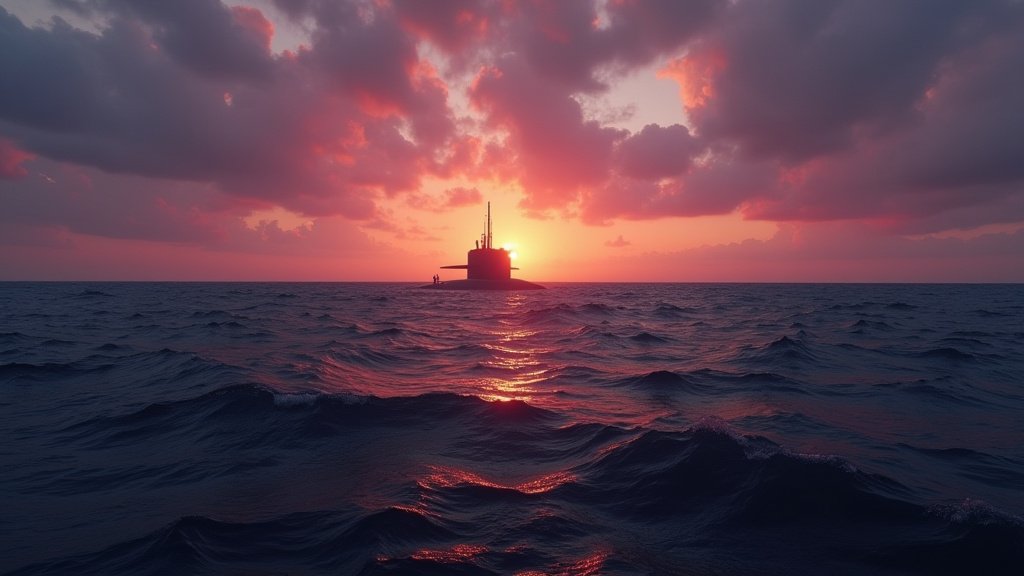
China’s Rare Ballistic Missile Test Raises Concerns
China conducted a rare test-launch of a long-range ballistic missile from a nuclear submarine in the Pacific Ocean, drawing protests from the US and countries in Asia and the Pacific. This launch, part of a “military training program,” highlights Beijing’s increasing military strength and capability in its nuclear deterrence strategy. Experts suggest the move exacerbates rising militarization in Asia, with the missile capable of reaching distant adversaries. This event occurred amidst growing concerns over China’s expanding nuclear arsenal under President Xi Jinping.
Key Highlights
- Rare Submarine Missile Test: China conducted a long-range ballistic missile test from a nuclear-powered submarine in the South Pacific, a rare event marking a significant step in its nuclear triad development.
- Regional Protests: The test drew immediate criticism and protests from the US, Australia, New Zealand, Japan, and Taiwan, who expressed concerns over regional stability and China’s military buildup.
- Enhanced Deterrence: The launch demonstrates China’s growing military strength and its enhanced capability in nuclear deterrence, with the missile capable of reaching distant targets.
- Nuclear Arsenal Expansion: The event occurs as China, under President Xi Jinping, is noted for one of the world’s fastest expansions of its nuclear arsenal.
- South Pacific Nuclear Free Zone: The missile was fired into the South Pacific Nuclear Free Zone, established by the Treaty of Rarotonga, raising questions about compliance with regional non-proliferation agreements.
China’s Expanding Nuclear Posture and Regional Ramifications
The July 6, 2026, test launch of a long-range ballistic missile from a Chinese nuclear-powered submarine in the South Pacific represents a pivotal moment in the evolving geopolitical landscape of the region. This event, described by China as a “routine military training program,” has been met with significant apprehension and condemnation from global powers, notably the United States, Australia, Japan, and New Zealand. The launch underscores China’s deliberate strategy to bolster its nuclear deterrence capabilities, extending its reach and survivability through a modern, sea-based nuclear arsenal. Analysts interpret this as a clear signal of Beijing’s burgeoning military might and its commitment to projecting power across vast distances, a development that exacerbates existing concerns over rising militarization in Asia.
Validating the Nuclear Triad and Second-Strike Capability
For decades, China’s strategic nuclear deterrent primarily relied on land-based intercontinental ballistic missiles (ICBMs) housed in silos or mobile launchers. However, the recent test signifies a crucial validation of its submarine-launched ballistic missile (SLBM) program, bringing China closer to a fully operational nuclear triad—a robust mix of land, sea, and air-based nuclear delivery systems. Experts suggest the missile tested was likely a new-generation JL-3 SLBM, capable of ranges exceeding 10,000 kilometers. This capability is vital for a “second-strike” strategy, ensuring China can retaliate even after absorbing a first nuclear strike. The successful test from a submerged submarine demonstrates a more survivable and harder-to-detect nuclear deterrent, significantly enhancing Beijing’s strategic posture and its ability to threaten distant adversaries. This development is seen as a component of President Xi Jinping’s broader initiative to modernize and expand China’s nuclear arsenal, which analysts describe as the world’s fastest-growing.
International Condemnation and Regional Tensions
The international reaction to the missile test was swift and largely critical. Australia’s Foreign Minister Penny Wong described the launch as “destabilizing to the region” and noted that it occurred in the context of China’s “rapid military buildup, which is lacking in transparency and reassurance as to intent”. New Zealand’s Foreign Minister Winston Peters labeled the development “unwelcome and concerning,” emphasizing that the Pacific should not accept such tests becoming normalized. Japan’s government urged China to reconsider its missile testing to avoid posing security risks. Taiwan viewed the test as an attempt by China to intimidate the international community. Notably, the missile was fired into the South Pacific Nuclear Free Zone, established by the 1986 Treaty of Rarotonga. China had pledged in 1987 not to test nuclear weapons within this zone or threaten signatories. This breach, or perceived breach, of regional non-proliferation norms has amplified concerns among Pacific Island nations. The test also coincided with the signing of a new defense treaty between Australia and Fiji, aimed at countering Chinese influence in the region, further heightening regional sensitivities.
China’s Response and Strategic Signaling
Beijing has maintained that the missile test was a “routine military training program” conducted in accordance with international law and practice, urging other countries not to “over-interpret” the event. A spokesperson for China’s Ministry of Foreign Affairs stated that the launch was not directed at any specific country or target. However, international observers interpret the timing and nature of the test as a deliberate strategic signal. Analysts suggest that China aims to compel the United States to treat it as a more equal strategic partner and to demonstrate its growing assertiveness in the Indo-Pacific. Lyle Morris, a senior fellow at the Asia Society Policy Institute’s Center for China Analysis, noted that the announcement signifies that “China’s nuclear deterrent is no longer centered solely on land-based missiles”. The demonstration of its sea-based nuclear strike capability is seen as a powerful assertion of its superpower status and its intent to safeguard its core interests.
Expanding Nuclear Arsenal and Future Implications
The missile test is emblematic of a broader trend: China’s rapid expansion of its nuclear arsenal. The Pentagon’s latest report estimates China’s stockpile at around 600 nuclear warheads in 2024, with projections indicating a rise to over 1,000 by 2030. This modernization and expansion of its nuclear triad—land, sea, and air-based delivery systems—is a cornerstone of China’s evolving nuclear strategy, which centers on “assured retaliation” and maintaining a credible second-strike capability. While China officially maintains a No First Use (NFU) policy, experts question whether this stance will hold as its arsenal grows and geopolitical tensions increase. The implications for regional and global strategic stability are profound. The test is likely to fuel demands for increased defense spending and enhanced security cooperation among US allies in the region. It also presents a challenge for arms control advocates, as bringing China into future arms control agreements remains a complex undertaking. The ongoing militarization and the lack of transparency surrounding China’s nuclear intentions continue to be a primary source of concern for nations across the Asia-Pacific.
FAQ: People Also Ask
Q1: What type of missile did China test?
A1: Analysts believe the missile tested was likely a new-generation JL-3 submarine-launched ballistic missile (SLBM), which has a range exceeding 10,000 kilometers.
Q2: Why is this missile test considered rare and concerning?
A2: It is rare because it was launched from a nuclear-powered submarine in the South Pacific, and it marks a significant step in China’s development of its nuclear triad and second-strike capability. It is concerning due to its potential to destabilize the region and its occurrence amidst China’s rapid nuclear arsenal expansion.
Q3: Which countries protested or expressed concerns about the missile test?
A3: The United States, Australia, New Zealand, Japan, and Taiwan raised concerns or protested the missile test.
Q4: What is China’s official stance on the missile test?
A4: China described the test as a “routine military training program” conducted in accordance with international law, not directed at any specific country, and urged others not to “over-interpret” it.
Q5: How does this test relate to China’s nuclear triad?
A5: This test is seen as a crucial validation of China’s sea-based leg of its nuclear triad, bringing it closer to establishing a fully operational triad of land, sea, and air-based nuclear delivery systems.