
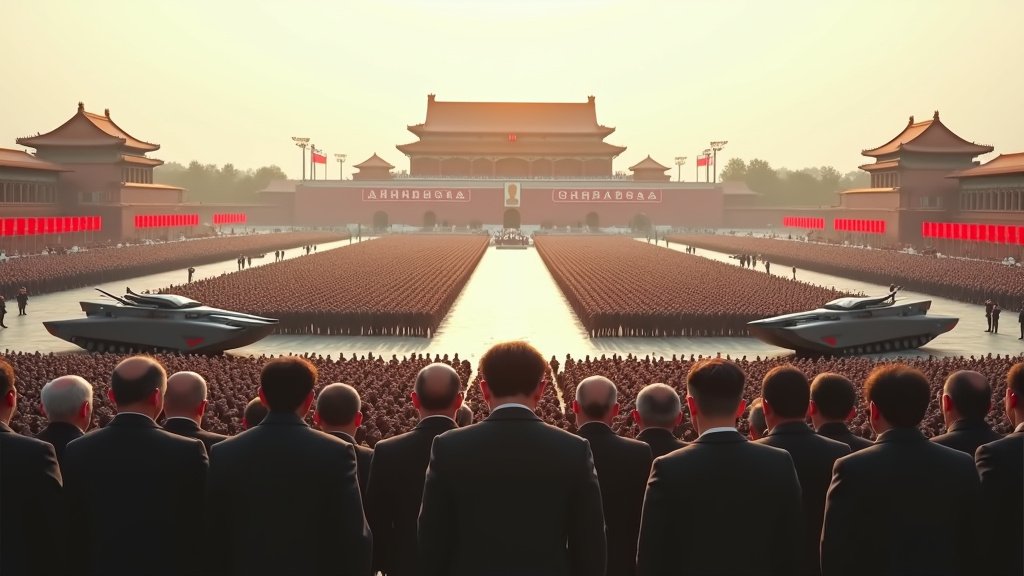
Beijing, China – September 3, 2025 – As China staged its largest-ever military parade to commemorate the 80th anniversary of its World War II victory, the nation simultaneously faced tragic news from eastern Afghanistan, where a devastating earthquake claimed thousands of lives and left a trail of destruction. The dual events painted a stark picture of a world grappling with both calculated displays of national power and the brutal force of nature.
China’s Grand Spectacle: A Display of Power and Shifting Alliances
On the morning of September 3, 2025, Tiananmen Square in Beijing transformed into a stage for a colossal military parade. Thousands of troops marched in precision, advanced weaponry rolled by, and fighter jets soared overhead, marking the 80th anniversary of China’s victory in the War of Resistance Against Japanese Aggression and the World Anti-Fascist War. This event, the second such grand commemoration since 2015, was designed to showcase China’s military modernization and historical narrative on a global scale.
President Xi Jinping, addressing the nation and a carefully curated international audience, underscored China’s commitment to peaceful development amidst global turbulence. “Humanity is once again faced with the choice of peace or war, dialogue or confrontation, cooperation or zero-sum games,” Xi declared, framing the current global landscape as one at a critical crossroads. He pledged that China would remain committed to the path of peaceful development and work towards building a community with a shared future for mankind.
The parade featured cutting-edge military hardware, including hypersonic missiles, drones, and new tank models, signaling China’s advancements in defense capabilities. More than 12,000 troops, over 100 aircraft, and hundreds of ground armaments were part of the meticulously orchestrated 70-minute display.
A significant aspect of the event was the presence of numerous foreign leaders, with 26 heads of state and government in attendance. Notably, Russian President Vladimir Putin and North Korean leader Kim Jong Un stood alongside President Xi, a powerful visual representation of deepening strategic ties. The gathering, which saw a conspicuous absence of leaders from most Western nations, was widely interpreted as a geopolitical statement, projecting an image of solidarity among nations seeking to reshape the existing world order and offering a counter-narrative to a US-dominated global system.
Afghanistan’s Calamity: A Nation Devastated by Earthquake
As Beijing displayed its military might, a different kind of crisis unfolded in eastern Afghanistan. A powerful magnitude 6.0 earthquake struck the region late on Sunday, August 31, 2025, just days before China’s commemoration. The shallow quake, with an epicenter in the mountainous provinces of Kunar and Nangarhar, unleashed widespread destruction, particularly in poorly constructed villages.
By September 3, the death toll had tragically surpassed 1,400, with over 3,100 people reported injured. However, as rescue efforts continued into the subsequent days, figures from the Taliban authorities and international organizations indicated a grim reality: the number of fatalities climbed to over 2,200, with thousands more injured and approximately 7,000 homes destroyed or severely damaged. Entire villages were reduced to rubble, compounding the immense humanitarian challenges already faced by Afghanistan.
Rescue operations were severely hampered by the treacherous terrain, landslides triggered by the seismic activity, and extensive damage to roads and infrastructure. Many remote communities were cut off, forcing aid workers and local residents to trek for hours on foot to reach survivors trapped under debris. Numerous aftershocks, including several above magnitude 5, further complicated efforts and instilled fear among the already traumatized population.
International aid agencies and countries began responding, but the scale of destruction, coupled with Afghanistan’s ongoing economic hardship and a significant funding gap for humanitarian aid, presented formidable obstacles. The UN, along with various international bodies, pledged support, but the immediate needs for shelter, food, medical supplies, and clean water were immense, particularly as winter approached.
A World of Contrasts: Power and Peril
The concurrent events of September 3, 2025, served as a potent reminder of the world’s complex realities. While Beijing projected an image of strength, historical remembrance, and growing global influence through its meticulously organized military parade, a humanitarian catastrophe was unfolding in Afghanistan. The stark contrast highlighted the dual nature of news today: geopolitical maneuvering on one hand, and the devastating impact of natural disasters on vulnerable populations on the other. The international community’s attention was divided, grappling with diplomatic alignments and the urgent call for humanitarian aid in a world marked by both assertive power projections and profound human suffering.