
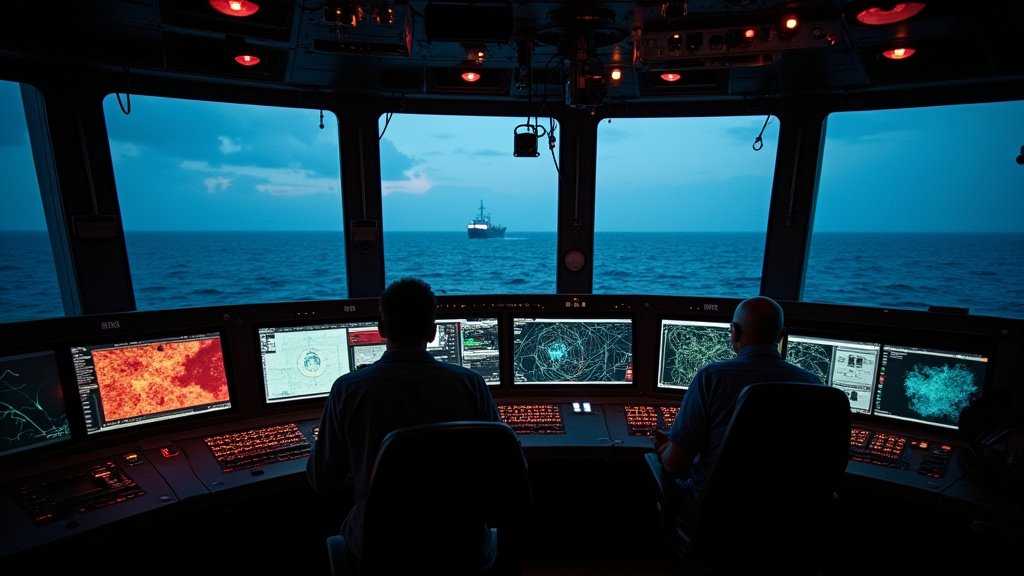
The United States Coast Guard continues to serve as the nation’s primary maritime defense against the flow of illicit cargo into the Western Hemisphere. Recent operations conducted by Coast Guard cutters in both the Eastern Pacific and the Caribbean Sea have resulted in the interdiction and seizure of narcotics valued at over $53 million. This significant operational success underscores the relentless tempo of maritime law enforcement agencies operating in high-risk zones, where Transnational Criminal Organizations (TCOs) employ increasingly sophisticated methods to bypass border security protocols.
Key Highlights
- Multi-Theater Execution: The operation spanned two distinct maritime theaters, demonstrating the Coast Guard’s reach and agility in managing simultaneous interdictions across disparate oceanic corridors.
- Disrupting TCO Logistics: By seizing $53 million in contraband, the USCG has directly impacted the revenue streams and logistics networks of organized crime groups that utilize go-fast vessels and semi-submersibles to move product.
- Integrated Task Force Coordination: The success of these interdictions relies heavily on intelligence sharing and command integration provided by the Joint Interagency Task Force South (JIATF-S), which coordinates international assets to track suspicious vessels.
- High-Tempo Readiness: The ability to execute these missions despite the vast, unpredictable nature of the open ocean serves as a testament to the training of the cutter crews and the versatility of modern maritime defense technology.
The Anatomy of a Maritime Interdiction
The Operational Landscape: Pacific vs. Caribbean
The illicit drug trade in the Western Hemisphere is not a monolithic challenge; it is a bifurcated logistical nightmare for law enforcement. The Eastern Pacific corridor and the Caribbean transit zones present vastly different operational environments. In the Eastern Pacific, TCOs frequently utilize ‘go-fast’ boats—small, low-profile, and exceptionally high-speed vessels—that run deep into the open ocean to avoid coastal detection. These routes are characterized by vast, featureless stretches of water where surveillance assets must cover thousands of square miles of ocean.
Conversely, the Caribbean transit zone is defined by its complex archipelagic structure. Criminal organizations use this geography to weave through islands, masking their movements among legitimate maritime traffic. The USCG’s ability to operate effectively in both theaters requires a sophisticated mix of assets: long-range National Security Cutters (NSCs) capable of staying at sea for weeks, paired with agile Fast Response Cutters (FRCs) that can maneuver in tighter, shallower waters. This $53 million seizure reflects the successful convergence of these different platform types, working in tandem to squeeze out the operational space for illicit smugglers.
Technological Force Multipliers in Modern Seizure
Gone are the days when maritime interdiction relied solely on visual detection from the bridge of a cutter. Today’s counter-narcotics missions are data-driven. The integration of long-range surveillance drones (UAVs) and satellite-based maritime domain awareness (MDA) allows the Coast Guard to identify suspicious patterns before a vessel is even visually acquired. Intelligence analysts at JIATF-S fuse information from international partner nations, commercial vessel tracking data, and human intelligence to create a ‘common operating picture.’
When a potential target is identified, the transition from surveillance to interdiction is a high-speed, high-stakes evolution. Coast Guard crews utilize Over-the-Horizon (OTH) interceptor boats deployed from the mother cutter. These vessels are designed for speed and maneuverability, allowing boarding teams to catch, inspect, and secure vessels that would otherwise outpace traditional patrol craft. The recent $53 million seizure is a testament to this technological ecosystem; without the ability to track and intercept in real-time, these loads would likely have reached coastal drop-off points, multiplying their street value exponentially as they transitioned inland.
The Geopolitical and Economic Ripple Effects
Beyond the raw dollar value of the seized narcotics, the secondary impacts of these interdictions are profound. The flow of narcotics into the U.S. is not merely a border issue; it is a public health and public safety crisis that fuels violence, corruption, and instability in source and transit countries. When the Coast Guard interdicts a multi-million dollar load, they are effectively starving the supply chain of the capital required to purchase more advanced, stealth-capable vessels and to bribe local officials in transit nations.
Furthermore, the Coast Guard’s presence serves a diplomatic function. By patrolling the Eastern Pacific and Caribbean, the U.S. demonstrates a commitment to regional security, frequently partnering with navies from Central and South American nations. These partnerships turn international waters into a more hostile environment for smugglers. Every seizure serves as a deterrent; while TCOs constantly adapt, each successful interdiction forces them to increase their operational costs, making the trade less profitable and more risky. This ‘cost of doing business’ strategy is a vital component of the broader U.S. National Security Strategy, aiming to weaken the TCOs from the outside in.
Future Outlook: The Autonomous Sea
Looking ahead, the nature of these operations is poised for an evolution. As TCOs begin experimenting with semi-autonomous submersible vessels—some of which are built with very low profiles to avoid radar and visual detection—the Coast Guard is pivoting toward more advanced sensor packages. We are likely to see an increase in the use of AI-driven pattern recognition software that can distinguish between a fishing vessel and a drug runner based on subtle anomalies in movement, speed, and heading. The $53 million haul reported today is a significant win, but it also signals that the arms race at sea is only accelerating. The next chapter of this conflict will be defined not just by the speed of the cutter, but by the speed of the intelligence loop.
FAQ: People Also Ask
1. How does the U.S. Coast Guard track these illicit vessels in such a massive ocean?
The Coast Guard uses a combination of ‘maritime domain awareness’ tools, which include satellite tracking, long-range maritime patrol aircraft (like the HC-130 Hercules), and intelligence sharing from partner nations. Once a suspicious vessel is identified, it is tracked via radar and sensor fusion until an interceptor cutter can be positioned to make the stop.
2. What happens to the drugs after they are seized?
Once the narcotics are seized and secured, they are handled as evidence for potential federal prosecution. After the legal proceedings are concluded and the evidence is no longer required for trial, the contraband is typically destroyed under strict supervision to ensure it does not re-enter the supply chain.
3. Do Coast Guard crews get into armed confrontations during these seizures?
While many interdictions are peaceful, the potential for violence is significant. Coast Guard boarding teams are highly trained in tactical boarding procedures and are prepared to escalate force if the subjects on the vessel resist or engage in hostile action. The safety of the crew is paramount, and they employ non-lethal and lethal force capabilities commensurate with the threat level presented by the smugglers.
4. Why is the Eastern Pacific corridor specifically targeted for these operations?
The Eastern Pacific corridor is a primary transit route for smugglers bringing narcotics from South America to North American markets. Its vastness and lack of consistent air or sea surveillance by smaller local nations make it an attractive ‘highway’ for drug runners, necessitating a robust, long-term U.S. presence to disrupt these established logistics networks.