
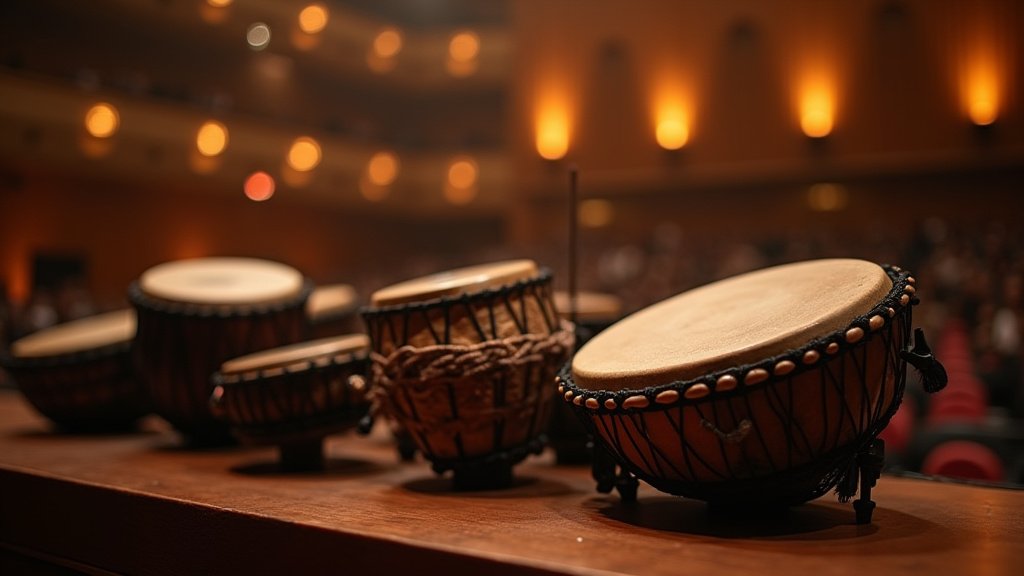
Oakland University’s School of Music, Theatre and Dance (SMTD) transforms its stage into a vibrant mosaic of international sound this evening, April 17, with a highly anticipated World Music Concert featuring renowned musician Haruna Walusimbi. This event serves as a centerpiece of the university’s spring cultural programming, offering attendees a profound exploration of African and Caribbean musical heritage. By weaving together complex rhythms, melodic storytelling, and traditional instrumentation, the performance aims to foster a deeper understanding of cultural intersectionality within the academic community.
Key Highlights
- Headline Performance: Renowned artist Haruna Walusimbi takes center stage, bringing authentic global instrumentation and traditional performance techniques to the Oakland University campus.
- Cultural Heritage Exploration: The program focuses on the deep connections between African and Caribbean musical traditions, showcasing the evolution of rhythmic structures and thematic storytelling.
- Artistic Integration: The concert is part of the SMTD’s broader mission to integrate diverse global perspectives into the conservatory-style curriculum, providing students and faculty with interdisciplinary exposure.
- Educational Impact: Beyond entertainment, the event highlights the pedagogical importance of ethnomusicology, encouraging a dialogue between traditional cultural forms and contemporary performance art.
A Global Tapestry: The Significance of the World Music Concert
The decision to host a world music concert dedicated to African and Caribbean heritage is more than a simple scheduling choice; it is a strategic and artistic commitment by Oakland University’s School of Music, Theatre and Dance to expand the definition of conservatory education. In an era where globalization has fundamentally altered the landscape of contemporary music, the ability to interpret and perform non-Western musical styles is becoming an essential skill for modern musicians. Haruna Walusimbi, a musician celebrated for his mastery of traditional instruments, brings an authenticity to the stage that challenges the audience to listen beyond the familiar structures of Western classical and popular music.
The Role of Haruna Walusimbi
Haruna Walusimbi represents a vital link in the chain of traditional music preservation. Musicians of his caliber function not just as performers, but as cultural archivists. In his approach to the music of the African diaspora, Walusimbi utilizes instruments that carry centuries of history, each note serving as a connection to ancestral practices. At Oakland University, his presence provides students with an invaluable masterclass in technique, improvisation, and the delicate balance between maintaining tradition and embracing innovation. This concert offers an immersive experience where the audience can witness the nuance of percussive interaction and vocal storytelling that defines much of the African and Caribbean musical experience.
African and Caribbean Musical Intersectionality
The thematic focus of tonight’s concert—the intersection of African and Caribbean heritage—is a subject of immense historical and musicological depth. The musical traditions of the Caribbean are inextricably linked to the African diaspora, created through the forced and voluntary movement of people, cultures, and ideas. This concert highlights the ‘creolization’ of sound: the way rhythmic patterns, such as the clave or the syncopated basslines characteristic of Caribbean genres, find their roots in the polyrhythmic traditions of West Africa. By presenting these styles in a singular concert, the SMTD is effectively teaching a lesson in history through sound, showing how music acts as a vessel for cultural memory and resilience.
Pedagogy and Performance in SMTD
For the students at Oakland University, this concert is a live case study in collaborative artistry. Music programs across the United States are increasingly moving away from a strictly Eurocentric model, pivoting toward a more holistic view of music history. Events like the World Music Concert are critical in this pedagogical shift. They allow students to step out of the practice room and into the realities of global performance. The preparation for such a concert involves not just technical proficiency, but the acquisition of ‘cultural competence’—the ability to approach, appreciate, and respectfully interpret a musical tradition that is not one’s own.
Breaking Boundaries in the Concert Hall
The venue itself, the Varner Studio Theatre, is traditionally associated with more formal, academic performance styles. By hosting a world music concert in this space, the department is engaging in a subtle form of spatial activism. It asserts that African and Caribbean music—which often thrives in community, dance, and outdoor settings—belongs in the formal concert hall as much as any orchestral work. This validation is powerful. It tells students and community members that the sounds of their heritage, or the sounds they are learning to love, are academically rigorous and artistically significant.
The Future of Cultural Programming at OU
As the Spring 2026 semester reaches its conclusion, this concert serves as a high note. The success of such events often determines the trajectory of future funding and scheduling. If the SMTD can successfully demonstrate that there is a hunger for diverse, world-focused programming, it paves the way for more guest artists, workshops, and interdisciplinary collaborations in the coming academic years. The goal is a cyclical ecosystem where student interests, faculty research, and community participation feed into one another, creating a university environment that is as dynamic and diverse as the music itself.
FAQ: People Also Ask
What makes this concert specifically significant for the university?
It represents a shift toward more inclusive, globalized conservatory education, moving beyond traditional Western-centric curricula to embrace the historical and technical depth of African and Caribbean musical traditions.
Who is the primary guest performer, and why does it matter?
The concert features Haruna Walusimbi. His inclusion is significant because he serves as an authentic practitioner and educator, providing students with direct, hands-on insight into the traditional techniques of the African diaspora.
Is this event open to the public?
Yes, the School of Music, Theatre and Dance events at Oakland University are typically open to the campus community and the public, though tickets are usually required, and attendees are encouraged to reserve them via the university’s online portal.
How do African and Caribbean musical styles differ and connect?
While they are distinct, they are deeply connected through the history of the African diaspora. Caribbean music often evolved from the rhythmic foundations of African music, adapted and transformed over centuries of cultural exchange, resulting in the unique, syncretic genres heard across the islands today.