
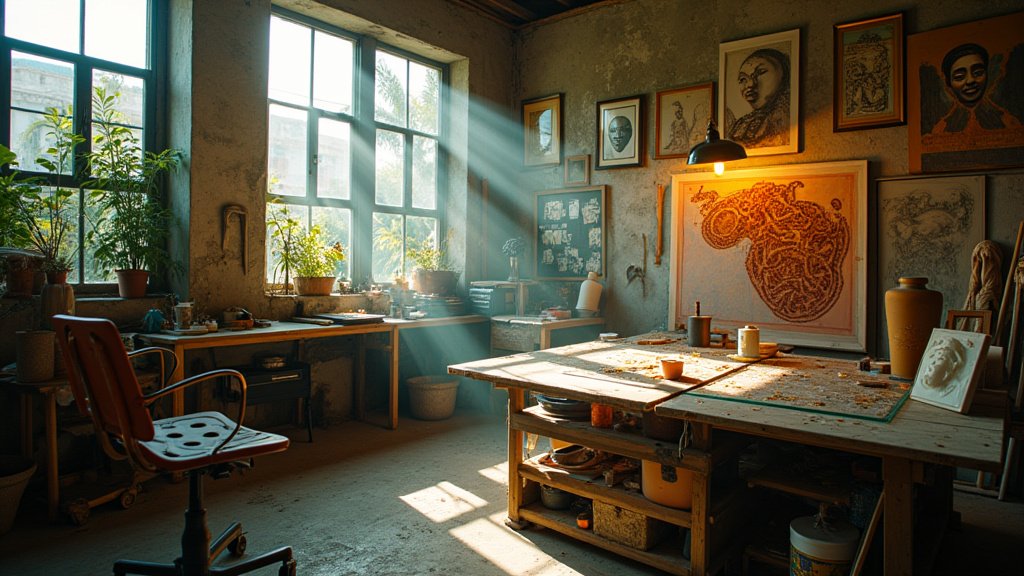
In a momentous convergence of local community and international prestige, Haitian-American artist Edouard Duval-Carrié is opening his private studio in Little Haiti for a rare, one-night-only preview of works that will soon define his presence at the 61st Venice Biennale. On Friday, April 24, 2026, the artist, often cited as a definitive voice in contemporary Caribbean art, will host the “Pre-Venice Studio Night: Tout moun fèt.” This event, presented in partnership with the Tout-Monde Art Foundation, offers an intimate, behind-the-scenes look at the creative process fueling his highly anticipated installation at one of the world’s most significant cultural exhibitions. By welcoming collectors, scholars, and the community into his workspace before the work embarks on its journey to Italy, Duval-Carrié is effectively turning his Miami studio into a staging ground for a global conversation about history, identity, and the enduring legacy of the Caribbean diaspora.
Key Highlights
- Exclusive Studio Preview: An intimate viewing of original works and sculptures conceived for the Venice Biennale, hosted in Duval-Carrié’s Little Haiti workspace.
- Academic Discourse: The event features a salon-style conversation between the artist and esteemed art historian Erica Moiah James, titled “Narrating Haiti through the Work of Edouard Duval-Carrié: Art, History, and Transformation on the Eve of the Venice Biennale 2026.”
- Community and Connectivity: Organized by the Tout-Monde Art Foundation, the program emphasizes the importance of keeping global-reaching art rooted in its source community.
- Thematic Depth: The installation centers on the Biennale’s theme, “Smaller Keys,” posing critical questions about the historical and cultural contributions of Africa to the global landscape.
- Cultural Celebration: The night transitions from intellectual inquiry to artistic celebration, featuring a set by DJ Gardy Girault and a showcase of Haitian culinary traditions.
The Alchemy of History: From Little Haiti to the Global Stage
For decades, Edouard Duval-Carrié has occupied a unique position in the art world, utilizing materials—from resin and engraved plexi to mixed media—that transform Caribbean history into luminous, layered narratives. His upcoming participation in the 2026 Venice Biennale is not merely a professional milestone; it is the culmination of years of rigorous archival inquiry and aesthetic innovation. By previewing the works in Little Haiti, Duval-Carrié ensures that the dialogue surrounding his art begins where the heart of his practice resides: within the vibrant, complex, and resilient Haitian community of Miami.
A Studio-Based Prelude to Global Art
There is a profound distinction between viewing art within the sterile, white-cube environment of an international gallery and experiencing it in the artist’s studio. At 225 NE 59th Street, the studio acts as a crucible. Here, the “Pre-Venice Studio Night” allows attendees to witness the context in which these pieces were born. When art is disconnected from its geography, it can sometimes lose the specific, urgent tension of its creation. By opening his doors, Duval-Carrié is making a statement: that the work destined for Venice is inextricably linked to the stories and the people of Little Haiti.
Vanessa Selk, the Founding Artistic Director of the Tout-Monde Art Foundation, has been instrumental in this bridge-building effort. Her philosophy, inspired by Édouard Glissant’s vision of the “Tout-Monde” (the All-World), seeks to create spaces where boundaries are fluid. By curating this preview, the Foundation is ensuring that the local community has a stake in the success of the Biennale project. “We wanted to make those works that were not going to Venice and staying in the studio were still accessible to all,” Selk notes, underscoring the shift towards democratizing art access—a stark contrast to the often exclusionary nature of elite art fairs.
The Curatorial Vision: “Smaller Keys” and African Influence
The 61st Venice Biennale, operating under the evocative title “Smaller Keys,” invites artists to reconsider marginalized histories and overlooked contributions. For Duval-Carrié, this is fertile ground. His work has long focused on the “neurological effects of immigration, exile, and displacement,” as he puts it.
In his current series, he tackles the monumental question: “What did Africa bring to the world?” This is not just a rhetorical inquiry; it is a visual excavation. Through his characteristic use of plexi and mixed-media framing, Duval-Carrié reconstructs the history of the Haitian Revolution, the trauma of the slave trade, and the persistence of Vodou traditions. The works destined for Venice are expected to be his most ambitious yet, challenging international audiences to view Haiti not as a nation of lack, but as a crucible of immense cultural wealth and endurance.
Historical Weight and Artistic Resonance
The academic component of the evening, led by scholar Erica Moiah James, provides the necessary intellectual scaffolding for the visual experience. The conversation between the artist and the historian aims to ground the ethereal nature of the art in the concrete, often painful history of the Caribbean. This is a critical secondary angle: the role of the contemporary artist as a public intellectual. By engaging in this dialogue, Duval-Carrié and James are not just explaining the art; they are mapping a genealogy of resistance and creativity that spans centuries.
Moreover, the inclusion of cultural elements—the Haitian buffet, the rhum bar, and the electronic music of DJ Gardy Girault—is a deliberate rejection of the idea that high art must be devoid of sensory pleasure. By weaving these elements together, the event captures the spirit of “Tout moun fèt” (Everyone is celebrated/Everything is a party), reinforcing that Haitian culture is characterized by both deep gravity and irrepressible joy.
FAQ: People Also Ask
What is the significance of the “Tout-Monde Art Foundation” in this event?
The Tout-Monde Art Foundation, led by Vanessa Selk, works to support Caribbean artists and connect them to international audiences. Their role in this preview is to ensure that while the artist moves toward a prestigious global platform like the Venice Biennale, the work remains accessible and relevant to the local Haitian diaspora community.
Why is the “Pre-Venice” studio night considered rare?
Most internationally exhibited art is curated, crated, and shipped well in advance of a Biennale. This preview offers a rare opportunity to see works related to the Biennale series in the very space where they were conceived, before they become part of the highly controlled environment of an international art exhibition.
How does the theme “Smaller Keys” apply to Duval-Carrié’s work?
“Smaller Keys” at the Venice Biennale encourages focusing on nuances and overlooked narratives. Duval-Carrié applies this by using his art to explore specific, layered histories of the Haitian diaspora and African contributions to the world, which are often left out of dominant historical narratives.
What can attendees expect from the studio event?
The event is structured in three parts: a VIP collector’s access, an intimate salon conversation between the artist and historian Erica Moiah James, and a cultural gathering featuring DJ Gardy Girault, providing a holistic experience that blends art, history, and community.