
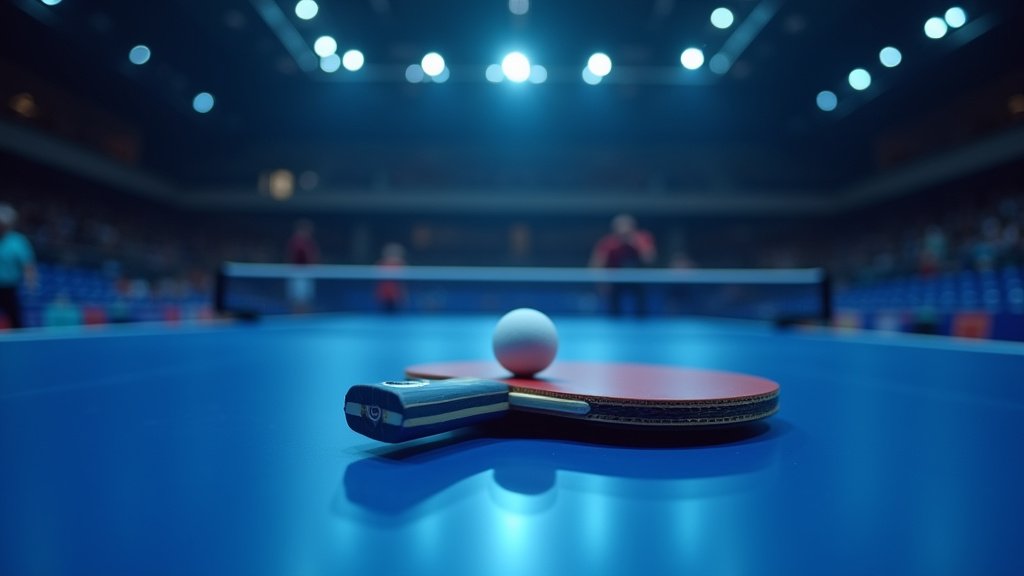
National champion Shemar Britton delivered a masterclass in resilience and tactical precision today at the Central American and Caribbean Championship in Santo Domingo, overcoming early-match adversity to secure a hard-fought advancement into the round of 32. The Guyanese star, known for his relentless offensive style, faced a grueling schedule that tested his endurance, yet his composure on the international stage proved decisive as he navigated a path through two intense encounters, solidifying his position as a formidable contender in the regional tournament.
Key Highlights:
- Shemar Britton clinched a berth in the round of 32 after an electrifying 3-2 comeback victory over world-ranked Dominican Republic player Rafael Cabrera.
- Britton opened his campaign with a dominant 3-0 straight-sets victory against Gabriel Quiros, demonstrating his high-level form and technical superiority.
- This advancement arrives as a significant milestone for Guyana’s table tennis contingent, highlighting Britton’s individual growth and his role as the team’s most seasoned competitor.
Dominating the Table: Britton’s Strategic Surge
The Central American and Caribbean Championship serves as a critical litmus test for elite athletes in the region, and Shemar Britton’s performance in Santo Domingo has been nothing short of transformative. Competing in an atmosphere charged with high stakes and regional pride, Britton has emerged as a headline figure for Guyana, showcasing a blend of raw power and defensive adaptability that has left opponents and spectators alike impressed. His journey through the initial stages of the tournament has highlighted not just his physical prowess, but the mental fortitude required to compete at the highest level of international table tennis.
Opening Round Precision: The Quiros Encounter
Britton’s campaign began with a commanding statement. Taking on Gabriel Quiros, Britton approached the table with a tactical clarity that quickly unraveled his opponent’s strategy. From the opening serve, Britton dictated the pace, utilizing deep, spin-heavy shots that forced Quiros into defensive errors. The 3-0 sweep—with set scores of 11-7, 11-6, and 11-8—was a display of efficiency. By neutralizing Quiros’s attempts to establish rhythm, Britton ensured that he preserved his energy for the challenges that would inevitably follow in the bracket.
This early success was pivotal. In tournament play, where fatigue and momentum shifts can derail even the most talented players, a clean opening victory acts as a force multiplier. It allowed Britton to acclimate to the specific lighting and table speed of the Santo Domingo venue, while simultaneously sending a signal to the rest of the field that he was operating at peak performance. The clinical nature of this win underscored the rigorous training regimen he has been undergoing, emphasizing his preparation for the specific nuances of the regional court.
The Resilience Factor: Overcoming the Cabrera Challenge
If the first match was a demonstration of dominance, the encounter with the Dominican Republic’s Rafael Cabrera was a testament to grit. Facing a world-ranked opponent on their home turf is a challenge that has humbled many seasoned athletes, and the early stages of the match suggested an uphill battle for the Guyanese national champion. Cabrera, utilizing crowd momentum and a precise blocking game, surged to a 2-0 lead, claiming the first two sets 12-10 and 11-4. For many, a deficit of that magnitude against a high-caliber opponent would be insurmountable.
However, Britton’s response was a masterclass in psychological recalibration. He did not tighten up or play conservatively. Instead, he made tactical adjustments, opting to play closer to the table to stifle Cabrera’s attacking angles. The shift in momentum began in the third set, which Britton narrowly won 12-10. This success broke the tension. With the momentum swung in his favor, Britton proceeded to dismantle the defensive structure of his opponent, taking the final two sets 11-4 and 11-9. This come-from-behind victory was more than just a win; it was an affirmation of his technical growth, proving that he can solve complex tactical puzzles under immense pressure.
Regional Impact and The Future of Guyanese Table Tennis
Britton’s advancement represents a broader narrative regarding the evolution of table tennis in the Caribbean. For years, the region has been working to bridge the gap with international powerhouses, and performances like Britton’s are the tangible results of those efforts. His success, alongside teammates Jonathan Van Lange, Elishaba Johnson, and Niron Bissu, reflects a collaborative environment where shared experience—even in the face of losses to formidable teams like Mexico and El Salvador—is fostering a new generation of talent.
Looking toward the future, this tournament is not an end point but a vital stepping stone. The experience gained in Santo Domingo is already being parlayed into preparations for the larger CAC Games. Britton has consistently spoken about the “dream of playing at this level,” and his actions on the court are clearly aligned with that ambition. By consistently pushing past the round of 32 in various tournaments, he is setting a new benchmark for what is possible for Guyanese athletes in the sport, effectively shifting the paradigm from ‘participation’ to ‘contention.’
As the bracket moves into the later stages, the focus for Britton will be on maintaining the physical endurance required for multi-day, multi-match competition. The physical toll of such intense rallies, combined with the mental drain of high-stakes competition, means that his recovery routines and off-court preparation will be just as crucial as his footwork and backhand speed. His ability to remain calm under the pressure of the elimination rounds will be the defining factor in how deep he can go, but based on his performance thus far, he has every reason to believe that a deep run is well within his reach.
FAQ: People Also Ask
Q: Who is Shemar Britton?
A: Shemar Britton is a prominent Guyanese table tennis player and the current national champion. He is widely recognized as one of the highest-ranked male table tennis athletes from the English-speaking Caribbean and a key figure in regional sports.
Q: What is the significance of the Central American and Caribbean Championship?
A: This championship is a premier regional sporting event that serves as a critical competition for ranking and qualification. Success in this tournament often acts as a qualifier for larger international events, including the CAC Games, and provides athletes with essential exposure to world-class competition.
Q: Where is the tournament being held?
A: The 2026 Central American and Caribbean Championship is currently taking place in Santo Domingo, Dominican Republic, drawing top talent from across the region to compete in various categories.
Q: What is next for Shemar Britton and Team Guyana?
A: Following his advancement in the singles category, Britton continues his campaign in the tournament. Additionally, the team is actively using these events to prepare for the upcoming CAC Games, focusing on tactical development and gaining experience against world-class players.