
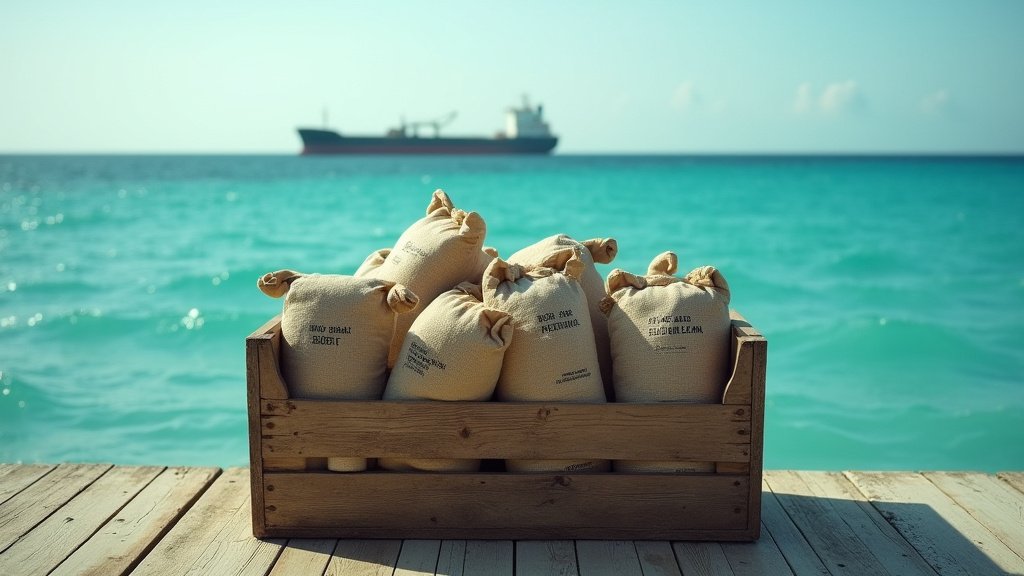
The ripples of the ongoing Middle East conflict are moving far beyond the Levant, crashing against the shores of the Caribbean as regional leaders issue urgent warnings regarding the stability of food supply chains. Wendell Samuel, Assistant Secretary-General of CARICOM, has sounded the alarm, highlighting that the region’s acute dependency on imported fuel and essential commodities leaves its populations uniquely vulnerable to the price shocks currently rattling global markets. As geopolitical tensions disrupt the Strait of Hormuz and drive fertilizer costs upward, Caribbean nations are facing a silent economic emergency that threatens both household welfare and long-term social stability.
The Anatomy of the Supply Chain Squeeze
At the heart of the crisis lies the disruption of global logistics. The Middle East remains a critical artery for the world’s energy and fertilizer trade. When the Strait of Hormuz—a vital maritime chokepoint—becomes a theater of tension or conflict, the impact is immediate. Container vessels are rerouted, insurance premiums for cargo skyrocket, and fuel prices at the pump reflect the volatility of the global energy market. For the Caribbean, which acts primarily as a net importer of food and agricultural inputs, these disruptions are not theoretical; they are inflationary.
Fertilizer is a particularly critical factor. Modern agriculture relies heavily on nitrogen-based fertilizers, much of which is derived from natural gas. When energy markets are upended by conflict, fertilizer prices spike. For Caribbean farmers, who are already grappling with the challenges of climate change and hurricane recovery, the increased cost of these essential inputs makes the production of local food prohibitively expensive. This creates a vicious cycle: local production costs rise, imports become more expensive, and the purchasing power of the average Caribbean consumer erodes rapidly. The result is a tightening noose of food insecurity that threatens to widen existing socioeconomic divides.
Afreximbank and the $10 Billion Response
In a strategic effort to insulate member states, the African Export-Import Bank (Afreximbank) has announced a significant $10 billion Gulf Crisis Response Programme (GCRP). This initiative is designed to provide immediate liquidity and foreign exchange support to African and Caribbean nations struggling with the fallout of the crisis. The GCRP aims to help nations sustain essential imports—including fuel, LNG, and food—during periods of extreme market volatility.
However, liquidity is a temporary bandage on a chronic condition. While the Afreximbank initiative provides a necessary buffer against immediate shocks, it underscores a deeper realization among policymakers: the region cannot continue to operate as a passive recipient of external market shocks. The GCRP is not just about financial aid; it is about infrastructure and trade logistics. By providing pre-export finance and supporting the scaling of productive capacity, the program attempts to turn the tide, encouraging nations to capitalize on their strategic commodities rather than merely suffering from the volatility of others.
The Strategic Pivot: Reimagining 25 by 2025
For years, CARICOM has promoted the ’25 by 2025′ initiative, a bold plan aimed at reducing the region’s massive multi-billion dollar food import bill by 25 percent by 2025. This goal, now extended to 2030, has transitioned from an ambitious policy target to a matter of existential necessity. The ongoing conflict in the Middle East has provided a harsh, real-time proof-of-concept for why this sovereignty is required.
Agricultural experts within the region are arguing that the dependency on imported food is a structural vulnerability. Countries like Guyana, Jamaica, and Suriname hold the potential to become the breadbaskets of the region, yet they require massive capital investment in cold storage, farm-to-market road infrastructure, and irrigation technology. The current crisis has accelerated the urgency of these investments. It has shifted the conversation from abstract ‘food security’ to a concrete debate about logistics, maritime trade routes, and the creation of a regional, self-sustaining agricultural network that is insulated from global geopolitical whims.
The Hidden Costs of Global Interconnectedness
The crisis also highlights the ‘hidden’ costs of being a Small Island Developing State (SIDS) in an interconnected global economy. Beyond food, the disruption affects tourism and aviation sectors, which are the lifeblood of many Caribbean economies. As airlines adjust to higher fuel costs and shipping lines pass on surcharges, the cost of transport for both goods and services increases. This multi-layered inflation forces governments into a difficult dilemma: subsidize the cost of living and risk ballooning public debt, or pass the costs to the consumer and risk social unrest.
Wendell Samuel’s warning serves as a call to action for stronger regional coordination. He emphasizes that individual nations, often small and limited in fiscal space, cannot negotiate these global currents alone. The ‘CARICOM bloc’ model is essential here, allowing for collective bargaining power and pooled resources. By acting in concert, the region can better manage supply shocks, coordinate bulk purchasing to keep prices lower, and leverage the Afreximbank’s support to build genuine, shock-responsive infrastructure.
The Future of Caribbean Food Security
Looking ahead, the road to stability requires a complete overhaul of how the region approaches its food supply. The reliance on external markets has historically been convenient but is increasingly dangerous. The geopolitical landscape of 2026 suggests that ‘stability’ in global trade is no longer the default setting; volatility is the new normal. Therefore, the Caribbean’s economic strategy must pivot toward resilience.
This involves three primary pillars: First, the massive scaling of intra-regional trade to ensure that food grown in the southern Caribbean can reach islands in the north without being bottlenecked by international shipping costs. Second, the democratization of agriculture, encouraging more youth and women to enter the sector with modern, tech-enabled farming tools. Third, a proactive diplomatic and financial stance, such as the GCRP engagement, which secures the necessary capital to build the infrastructure that prevents the next crisis from becoming a disaster.
As the world watches the Middle East, the Caribbean is looking inward. The warning issued by CARICOM is clear: the era of assuming that global supply chains will always function as expected is over. The path forward is difficult, requiring sacrifice and significant investment, but it is the only way to ensure that the region’s future is determined by its own capacity to feed its people, not by the shifting tides of distant conflicts.
FAQ: People Also Ask
1. What is the ’25 by 2025′ initiative?
The 25 by 2025 initiative is a CARICOM-led strategy aiming to reduce the region’s massive food import bill by 25 percent. Originally set for 2025, it has been extended to 2030 to accommodate setbacks caused by climate events and global supply chain disruptions.
2. How does the Middle East war specifically impact Caribbean food prices?
The conflict disrupts oil and fertilizer production in the Middle East, which drives up global shipping costs and agricultural input prices (fertilizer). As the Caribbean imports most of its food, these higher costs are passed directly to the consumer.
3. What is the Gulf Crisis Response Programme (GCRP)?
It is a $10 billion initiative by the African Export-Import Bank (Afreximbank) designed to provide short-term liquidity and trade support to African and Caribbean nations to help them maintain essential food and fuel imports despite global market volatility.
4. Why is fertilizer so critical in this context?
Fertilizer is nitrogen-intensive, and its production is tied to natural gas prices. Because the Middle East is a primary energy hub, conflict-driven spikes in energy costs disproportionately increase the cost of farming, making locally grown food more expensive to produce and less competitive against imported alternatives.