
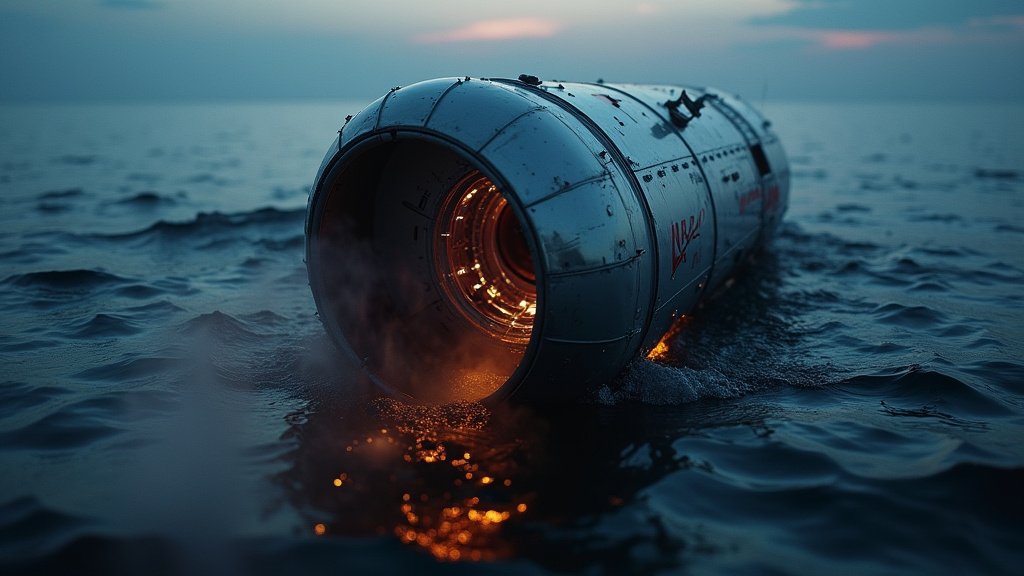
NASA’s Artemis II mission has successfully concluded, with the Orion spacecraft ‘Integrity’ splashing down in the Pacific Ocean on April 10, 2026, marking the first crewed return from the Moon in over half a century. The historic 10-day journey, which took four astronauts around the far side of the Moon and back, culminated in a textbook splashdown off the coast of San Diego at 8:07 p.m. EDT, proving that humanity is once again ready for deep-space exploration.
Key Highlights
- Successful Splashdown: The Orion spacecraft safely landed in the Pacific Ocean at 8:07 p.m. EDT on April 10, 2026, concluding a 10-day lunar odyssey.
- Crew Safety: All four crew members—NASA astronauts Reid Wiseman, Victor Glover, and Christina Koch, along with CSA astronaut Jeremy Hansen—have been safely recovered and are in good health.
- Historic Milestone: This marks the first time humans have orbited the Moon since the Apollo era, setting the stage for future lunar landings.
- Recovery Operations: The USS John P. Murtha led the recovery effort, securing the capsule and retrieving the crew via helicopter for immediate medical evaluation.
- Future Trajectory: The success of Artemis II provides critical data for the upcoming Artemis III mission, which aims to return humans to the lunar surface in 2027.
The Return of ‘Integrity’ and the Dawn of a New Lunar Era
The successful conclusion of the Artemis II mission is more than just a logistical triumph; it is a profound psychological and technical milestone for space exploration. For nearly three generations, the Moon has remained a distant object of study via robotic probes and orbital satellites. With the ‘Integrity’ capsule safely back on Earth, the barrier between humanity and our celestial neighbor has been decisively breached once more.
The Final Descent: Engineering the Re-entry
The re-entry phase of Artemis II was widely considered the most dangerous portion of the mission. As the Orion spacecraft slammed into Earth’s atmosphere at a velocity of approximately 23,864 miles per hour, it was subjected to temperatures reaching 2,760 degrees Celsius (5,000 degrees Fahrenheit).
During this intense 13-minute descent, the friction generated a plasma sheath around the capsule, causing a scheduled communication blackout that kept flight controllers at NASA’s Johnson Space Center in suspense. The heat shield, a critical component of the Orion design, performed flawlessly under extreme stress. As the spacecraft decelerated, the parachute sequence—a complex series of deployments—slowed the craft to a manageable speed for its final splashdown. This success confirms that the Orion architecture is robust enough to carry humans through the rigors of lunar returns, a vital prerequisite for the longer-duration missions planned for Mars.
The Crew’s Perspective and Contribution
Commanded by Reid Wiseman, with Pilot Victor Glover and Mission Specialists Christina Koch and Jeremy Hansen, the crew of Artemis II served as the vanguard for modern deep-space travel. Their mission was not merely to orbit the Moon but to test the systems that will sustain life during extended missions.
Jeremy Hansen’s presence on the mission highlights the essential role of international cooperation in the Artemis program. As the first Canadian to fly to the Moon, his participation underscores the collaborative nature of NASA’s Gateway project and the broader Artemis Accords. Throughout their 10-day journey, the crew conducted vital experiments and provided high-resolution imagery of the Moon’s far side, offering scientists unprecedented data to analyze the lunar surface’s changing conditions.
The Logistics of Recovery: USS John P. Murtha
Following the splashdown, the operation shifted to the U.S. Navy and recovery teams aboard the USS John P. Murtha. The precision required to locate a capsule moving at high speed, coordinate helicopter retrieval, and manage the medical assessment of astronauts who have just spent 10 days in microgravity is staggering. The successful extraction of Wiseman, Glover, Koch, and Hansen within minutes of splashdown reflects years of rigorous training and inter-agency coordination between NASA and the Department of Defense. This recovery protocol is now the gold standard for all future crewed splashdowns, ensuring that as we go further into space, our ability to bring explorers home remains constant.
Historical Context: From Apollo to Artemis
Comparing Artemis II to the Apollo missions is inevitable, yet distinct in purpose. Apollo was a race against time and geopolitical tension. Artemis is a structured, sustainable, and collaborative effort to build a permanent presence in space. The technology in Orion represents a quantum leap over the Command Modules of the 1960s, featuring advanced guidance systems, enhanced radiation shielding, and greater cabin comfort. Yet, the emotional resonance remains unchanged: watching humans return from the vicinity of the Moon is a powerful unifying event for the global public.
The Road Ahead: Artemis III and Beyond
With the successful conclusion of Artemis II, the focus immediately shifts to the next phase of the program. NASA has set an ambitious timeline for Artemis III, which is slated for 2027. Unlike its predecessor, Artemis III will feature a lunar landing, utilizing the Starship Human Landing System. The data collected from the Artemis II flight—specifically regarding the performance of life support systems, radiation exposure, and crew psychology during long-duration flight—will be fed directly into the planning for this next, even more complex mission. The success of this splashdown is the final “go/no-go” check that allows NASA to confidently move toward landing the first woman and person of color on the lunar surface.
FAQ: People Also Ask
Q: What was the primary goal of the Artemis II mission?
A: The primary goal was to verify the Orion spacecraft’s critical systems—including life support, guidance, and thermal protection—with a human crew on board during a deep-space trajectory, setting the stage for future landing missions.
Q: How did the Artemis II crew handle the communication blackout?
A: The communication blackout is a planned event caused by plasma buildup during re-entry. The crew followed automated procedures, and the spacecraft remained on its intended flight path until contact was restored.
Q: Is Artemis III still on track for 2027?
A: Yes. NASA officials have confirmed that the successful completion of Artemis II validates the core systems needed for Artemis III, which remains scheduled for 2027.
Q: What happens to the Orion capsule after recovery?
A: The Orion ‘Integrity’ capsule will be transported to U.S. Naval Base San Diego and then to NASA’s Kennedy Space Center. There, it will undergo detailed inspections, data retrieval, and post-flight analysis to assess how it withstood the mission.