
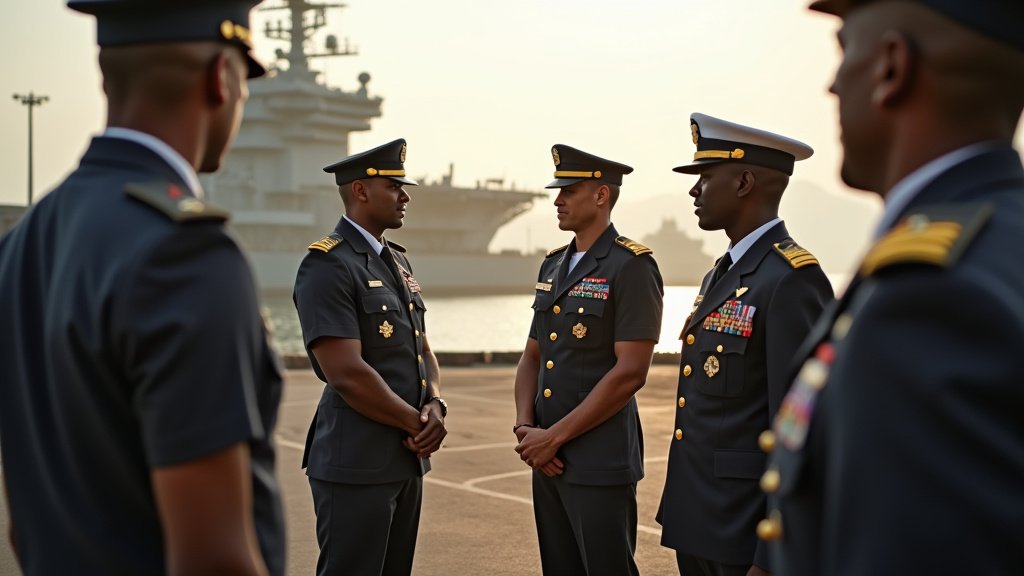
The Nimitz Carrier Strike Group has arrived in Kingston, Jamaica, marking a significant naval presence in the Caribbean. This deployment underscores the ongoing commitment to regional security and stability.
Key Highlights:
- The U.S. Navy’s Nimitz Carrier Strike Group is visiting Kingston, Jamaica.
- The visit is part of the group’s routine deployment in the Caribbean.
- This naval engagement highlights U.S. commitment to regional security.
- The group will engage in various professional interactions during its stay.
Naval Presence and Regional Engagement
Strategic Deployment in the Caribbean
The arrival of the Nimitz Carrier Strike Group (CSG) in Kingston, Jamaica, signifies a key moment in the U.S. Navy’s operational presence within the Caribbean theater. This deployment is not merely a port call but a deliberate strategic maneuver aimed at reinforcing alliances and demonstrating maritime power projection capabilities in a region of growing geopolitical importance. The Nimitz CSG, a formidable naval formation, typically includes an aircraft carrier, several escort warships, and a complement of aircraft, making its presence a clear signal of intent and capacity. This visit is part of a broader, routine deployment designed to enhance interoperability with regional partners and address shared security concerns, ranging from maritime domain awareness to counter-narcotics operations and humanitarian assistance.
Interoperability and Training Exercises
A critical component of such deployments involves fostering interoperability with the Jamaican Defence Force and other regional maritime forces. While specific exercises are often not disclosed in advance for security reasons, these engagements typically involve coordinated naval maneuvers, communication drills, and joint training scenarios. The objective is to ensure that allied forces can operate seamlessly together in a crisis, whether responding to natural disasters or addressing transnational threats. The exchange of expertise and best practices between U.S. Navy personnel and their Jamaican counterparts is invaluable, building trust and enhancing collective security capabilities.
Economic and Diplomatic Impact
Beyond military objectives, the visit of a U.S. Navy Carrier Strike Group has a tangible economic and diplomatic impact on the host nation. Port visits by large naval vessels stimulate local economies through the provisioning of ships, shore leave for thousands of sailors and officers, and various official engagements. Diplomatically, it reinforces the strong bilateral relationship between the United States and Jamaica, underscoring mutual interests in a secure and prosperous Caribbean. These interactions provide opportunities for cultural exchange and strengthen the people-to-people ties that form the bedrock of international relations.
Historical Context of U.S. Naval Presence
The U.S. Navy has a long history of operating in the Caribbean, dating back to the early 20th century. These operations have evolved from maintaining sea lanes and projecting power to more contemporary roles focused on regional security cooperation, counter-terrorism, and disaster relief. The Nimitz CSG’s visit is a modern manifestation of this enduring presence, adapting to the evolving security landscape of the 21st century while maintaining a consistent commitment to the stability and security of the Western Hemisphere. The carrier itself, a floating airbase, represents a significant technological and strategic asset, capable of projecting air power over vast distances.
FAQ: People Also Ask
What is the Nimitz Carrier Strike Group?
The Nimitz Carrier Strike Group (CSG) is a mobile, naval strike force centered on an aircraft carrier. It comprises an aircraft carrier (like the USS Nimitz), its embarked air wing, and a strike group of other naval vessels such as cruisers, destroyers, and submarines. These groups are highly capable units designed for a wide range of missions, including power projection, sea control, and supporting joint operations.
Why do U.S. Navy ships visit Jamaica?
U.S. Navy ships visit Jamaica as part of routine deployments to foster strong diplomatic ties, enhance regional security cooperation, and provide opportunities for professional military engagement. These visits also contribute to regional stability by demonstrating commitment and offering support for maritime security initiatives.
What are the main responsibilities of a Carrier Strike Group?
A Carrier Strike Group’s main responsibilities include projecting naval and air power, maintaining freedom of the seas, conducting humanitarian assistance and disaster relief operations, engaging in maritime security operations (like counter-piracy and counter-narcotics), and supporting U.S. foreign policy objectives abroad.
How does the U.S. Navy contribute to Caribbean security?
The U.S. Navy contributes to Caribbean security through forward presence, joint training exercises with regional partners, intelligence sharing, and supporting interdiction efforts against transnational criminal organizations. Carrier Strike Group deployments are a key element of this strategy, enhancing maritime domain awareness and deterring illicit activities.