
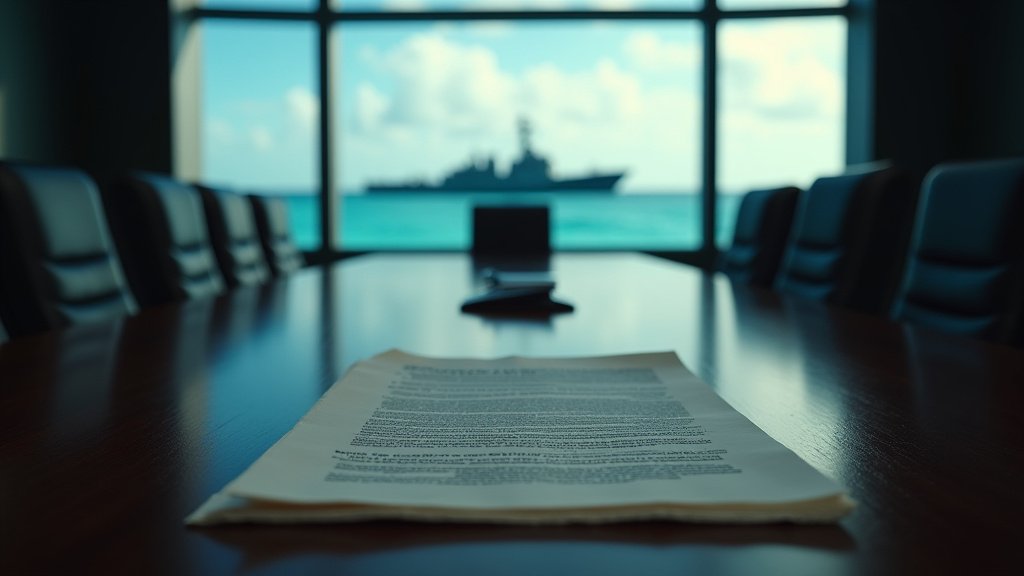
In a move that has sent shockwaves through the Caribbean, Trinidad and Tobago’s Prime Minister Kamla Persad-Bissessar has escalated her feud with regional neighbors, explicitly rejecting the longstanding “Zone of Peace” doctrine in favor of a closer security alliance with the United States. This pivot, which has transformed into a full-scale diplomatic confrontation, centers on the Prime Minister’s public dismissal of the Caribbean Community’s (CARICOM) regional neutrality, particularly regarding U.S. counter-narcotics and military operations near Venezuela. By branding the regional bloc’s security stance as “fakery,” Persad-Bissessar has not only deepened the divide within the 15-member organization but has also launched a direct campaign to force the departure of CARICOM Secretary-General Carla Barnett, effectively challenging the leadership structure of the bloc itself.
Key Highlights
- Diplomatic Pivot: Prime Minister Persad-Bissessar has publicly abandoned the traditional Caribbean “Zone of Peace” narrative, labeling it a functional failure in the face of modern security threats.
- Leadership Ultimatum: The T&T administration is aggressively campaigning for the removal of CARICOM Secretary-General Carla Barnett, citing deep-seated dissatisfaction with the bloc’s management and strategic alignment.
- US Alignment: T&T is actively supporting U.S. military logistics and counter-narcotics operations in the southern Caribbean, a move the opposition and several neighboring states fear creates a ‘vassal state’ dynamic.
- Opposition Outcry: Former Prime Minister Dr. Keith Rowley has emerged as the chief critic, accusing the current government of gambling with the nation’s sovereignty and decades of established regional diplomacy.
- Regional Fallout: The dispute threatens to destabilize CARICOM, as the bloc struggles to balance its internal sovereignty with the growing pressure of U.S. geopolitical interests.
The Sovereignty vs. Security Schism
The current diplomatic crisis is not merely a verbal spat; it is a fundamental collision between two opposing philosophies of Caribbean statecraft. For decades, CARICOM has operated on the principle of collective neutrality, attempting to insulate the region from the broader geopolitical clashes between the United States and Latin American powers, specifically Venezuela. This strategy, often referred to as maintaining the Caribbean as a “Zone of Peace,” was designed to prevent the region from becoming a theater for proxy conflicts or foreign military intervention.
However, Prime Minister Persad-Bissessar’s recent rhetoric marks a dramatic departure. Her administration argues that the “Zone of Peace” has become a “Zone of Peace fakery”—a diplomatic shield that she contends provides cover for illegal activities and allows the region to ignore the reality of evolving transnational threats. By openly supporting the presence of U.S. warships and authorizing logistical access to Trinidadian soil, the Prime Minister has effectively aligned Port of Spain with Washington’s regional security framework. This decision is viewed by her administration as a pragmatic necessity, asserting that the Caribbean cannot afford to remain a bystander while drug cartels and state-sanctioned criminal networks exploit the maritime gaps in the region.
The Campaign Against CARICOM Leadership
The tension reached a boiling point with the Prime Minister’s ultimatum regarding the CARICOM Secretariat. Persad-Bissessar has made it clear that she intends to leverage Trinidad and Tobago’s significant financial contribution—estimated at roughly 22% of the bloc’s annual budget—to exert influence over its future direction. Her demand for the exit of Secretary-General Carla Barnett upon the conclusion of her term in August serves as a rallying cry for those within the bloc who feel that the current Secretariat is too beholden to the status quo and insufficiently responsive to the demands of larger, more economically significant member states.
Critics within CARICOM argue that this is a dangerous power play. They contend that the Secretary-General’s role is to facilitate consensus among diverse nations, not to serve as an instrument for the national interests of any single member, regardless of their financial contribution. This internal dispute risks paralyzing CARICOM’s ability to function as a unified entity on the international stage, potentially eroding the bloc’s ability to negotiate trade deals or environmental protections as a collective voice.
Dr. Rowley’s Critique: The ‘Vassal State’ Warning
Central to the domestic political drama is the voice of former Prime Minister Dr. Keith Rowley. From the opposition benches, Rowley has waged a media campaign framing Persad-Bissessar’s policies as a betrayal of national independence. In a series of biting public statements, Rowley has characterized the decision to allow U.S. military access to local airports as an effective surrender of sovereignty.
Rowley, who during his tenure championed multilateralism and engaged with international forums like the UN to maintain a neutral, principled stance, argues that the current government is trading the country’s dignity for favor in Washington. His use of the term “vassal state” has resonated with a significant segment of the public who worry that the nation is becoming a pawn in the broader U.S.-Venezuela geopolitical tug-of-war. Rowley’s argument is rooted in historical precedent—the idea that Trinidad and Tobago, as a small nation, holds weight in the international community precisely because it refuses to be a satellite for superpowers. He warns that once that moral high ground is surrendered, it cannot easily be reclaimed.
The Economic and Strategic Stakes
Beyond the rhetoric and the political maneuvering lies a complex economic reality. Trinidad and Tobago is a major energy producer and a critical node in Caribbean commerce. Its decision to drift away from the regional consensus has profound implications for trade integration. CARICOM’s efforts to build a Single Market and Economy (CSME) rely on the premise of shared interests. If the bloc’s most significant industrialized member begins to pursue a foreign policy that actively diverges from the collective, the foundation of the CSME could weaken.
Furthermore, the U.S. involvement in the region is multifaceted. While the Persad-Bissessar administration emphasizes security and counter-narcotics, observers note the concurrent importance of energy security. With global shifts in energy policy, the U.S. has a vested interest in the stability of Caribbean energy producers. This has led to speculation that the PM’s alignment is not just about drugs and crime, but about securing long-term economic guarantees and investment from the United States at the expense of regional solidarity.
The Road Ahead: Potential for Fragmentation
The coming months will be critical. With the CARICOM leadership transition looming and the U.S. military presence in the region showing no signs of scaling back, the pressure on the T&T government will only mount. If Persad-Bissessar continues her confrontational approach, she risks isolating her nation from its immediate neighbors, potentially leading to a fragmentation of the Caribbean bloc. Conversely, if she succeeds in forcing a change in leadership and policy, she could redefine the future of Caribbean diplomacy, moving the region toward a more explicitly pro-Western security stance.
For now, the Caribbean remains in a state of diplomatic flux. The rhetoric from Port of Spain has set a new, combative tone, and the responses from Georgetown, Bridgetown, and other CARICOM capitals will define whether the bloc can survive this latest test of its unity or whether it will succumb to the realities of a shifting global order.
FAQ: People Also Ask
1. Why is the Trinidad and Tobago Prime Minister attacking CARICOM?
Prime Minister Persad-Bissessar is attacking the bloc because she believes it has become dysfunctional and is clinging to a “fake” narrative of neutrality (the ‘Zone of Peace’) that prevents effective security cooperation with the United States against regional threats like drug trafficking.
2. What is the ‘Zone of Peace’ doctrine in the Caribbean?
It is a long-standing diplomatic principle adopted by Caribbean nations to keep the region neutral and free from the military conflicts and power struggles of larger nations, particularly those involving the U.S. and Latin American neighbors.
3. How has the U.S. reacted to this shift?
While the U.S. has not officially commented on the internal political feud, the administration’s actions—such as utilizing T&T infrastructure for logistics—suggest a tacit approval of the current T&T government’s alignment with Washington’s regional security goals.
4. What are the potential consequences of this feud for Trinidad and Tobago?
The primary risks include diplomatic isolation from Caribbean neighbors, loss of influence within the CARICOM bloc, and domestic instability as the opposition frames the policy as a loss of national sovereignty.