
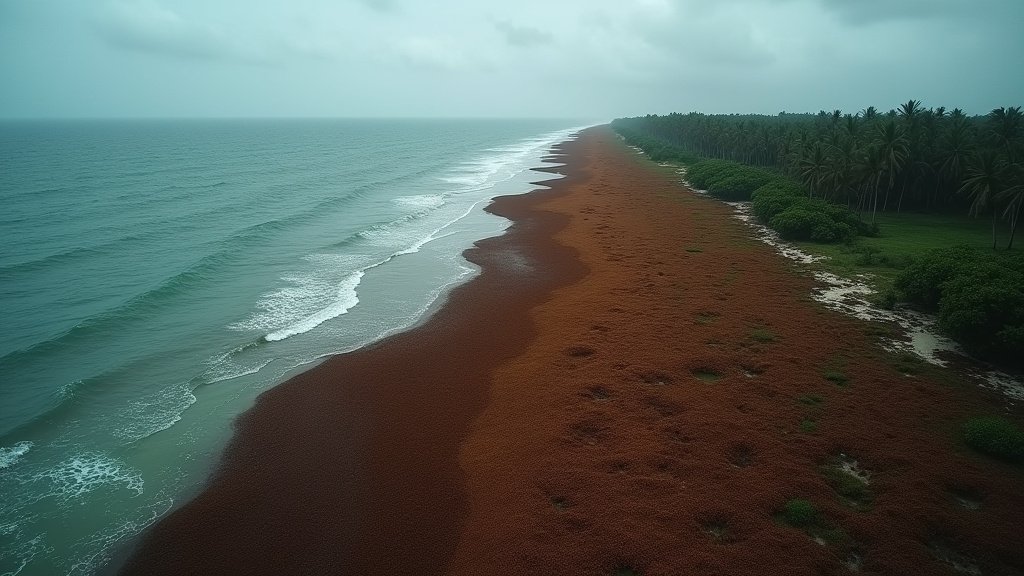
A massive influx of sargassum seaweed is overwhelming coastlines across Southeast Florida, the Florida Keys, and the Caribbean, creating an unprecedented environmental and economic challenge.
Key Highlights:
- Record-breaking sargassum quantities are impacting tourist destinations and local ecosystems.
- The thick mats of seaweed are causing significant beach erosion and impacting marine life.
- Local economies dependent on tourism and fishing are facing substantial financial losses.
- Scientists are investigating the causes, including climate change and nutrient runoff.
- Mitigation and cleanup efforts are proving costly and challenging to implement at scale.
Coastal Crisis: The Sargassum Deluge
Southeast Florida and the Caribbean are currently grappling with an unprecedented environmental crisis: a record-breaking arrival of sargassum seaweed. Vast, dense mats of the brown, algae-like macroalgae are inundating beaches from the Florida Keys to the islands of the Caribbean, creating a multi-faceted problem that stretches beyond mere aesthetic inconvenience. This influx poses significant threats to marine ecosystems, coastal economies, and the daily lives of residents and tourists alike. The sheer volume of sargassum this year is unprecedented, surpassing previous records and leaving local authorities and environmental agencies scrambling for solutions.
The Scale of the Invasion
The sargassum blooms, which originate in the Sargasso Sea, typically ebb and flow. However, recent years have seen a dramatic intensification and expansion of these blooms. Scientists point to a convergence of factors, including warmer ocean temperatures attributed to climate change, increased nutrient pollution from agricultural and wastewater runoff, and changing ocean currents. These conditions create a perfect storm for sargassum proliferation. The result is a relentless tide of seaweed washing ashore, piling up in thick layers that can reach several feet in depth. This not only smothers beaches, making them unusable for recreation, but also disrupts delicate coastal ecosystems.
Ecological Impacts
Beneath the surface of these seemingly benign seaweed mats, a complex ecological drama is unfolding. As sargassum decomposes, it releases hydrogen sulfide gas, which can deplete oxygen levels in the water, creating hypoxic zones that are deadly to fish and other marine life. The dense seaweed also physically blocks sunlight from reaching seagrass beds, which are vital nurseries for many species, including juvenile fish and conch. Furthermore, nesting sea turtles can struggle to reach traditional nesting sites on beaches covered by thick sargassum, and the hatchlings that do emerge can become entangled and perish in the debris. The sheer biomass of the sargassum also provides an unintended habitat for certain species, potentially disrupting the natural balance.
Economic Repercussions
For regions heavily reliant on tourism, the sargassum invasion represents a significant economic threat. Pristine beaches are a primary draw for visitors, and the presence of vast amounts of decaying seaweed, with its pungent odor, deters tourism. Hotels, restaurants, and other tourism-dependent businesses face decreased revenue as cancellations rise and visitor numbers dwindle. The fishing industry also suffers. Commercial fishing operations are hampered by the thick seaweed mats that clog nets and damage gear. Recreational fishing, a popular tourist activity, is also curtailed. The cost of sargassum removal and disposal is astronomical, placing a heavy financial burden on local governments and municipalities, many of which have limited resources.
Mitigation and Research Efforts
Communities are employing various strategies to combat the sargassum onslaught. Mechanical removal using front-end loaders and specialized beach rakes is common, but it is labor-intensive and costly. Efforts are underway to find beneficial uses for the collected sargassum, such as fertilizer, biofuel, or building materials, to offset removal costs and create a circular economy. Scientists are actively monitoring the blooms, studying their origins, and developing predictive models to help coastal communities prepare for incoming tides. Organizations like the Sargassum Monitoring Network and various university research institutions are at the forefront of this scientific endeavor. International cooperation is also crucial, as the sargassum originates in international waters and affects multiple nations.
FAQ: People Also Ask
What is sargassum and why is it washing ashore in record amounts?
Sargassum is a type of free-floating seaweed that forms large mats in the open ocean, particularly in the Sargasso Sea. It plays an important ecological role, providing habitat for marine life. Record amounts are washing ashore due to a combination of factors including rising ocean temperatures, increased nutrient pollution from land-based sources, and altered ocean currents, all of which promote rapid growth and facilitate its transport to coastal areas.
Is sargassum dangerous to humans?
Sargassum itself is generally not dangerous to humans. However, as it decomposes on beaches, it can release hydrogen sulfide gas, which has a strong rotten egg smell and can cause respiratory irritation in some individuals, especially in enclosed or poorly ventilated areas. Prolonged contact with large amounts of decomposing sargassum is also not recommended.
How are coastal communities dealing with the sargassum problem?
Coastal communities are employing a range of strategies, including mechanical removal from beaches, using specialized equipment to collect and haul away the seaweed. Some are exploring methods to use the collected sargassum for beneficial purposes like fertilizer, biofuel, or construction materials. Research institutions and government agencies are also working on predictive models and long-term solutions to manage the blooms.
Can sargassum be used for anything?
Yes, there is ongoing research and some implementation of using sargassum for beneficial purposes. It can be processed into fertilizer, used as a source for biogas or biofuel, incorporated into building materials, or even used in animal feed. Developing cost-effective and scalable methods for utilization is a key area of focus to help mitigate the economic burden of removal.
What is the connection between sargassum and climate change?
Climate change is believed to be a significant contributing factor to the increase in sargassum blooms. Warmer ocean temperatures accelerate the growth rate of sargassum. Additionally, changes in weather patterns and increased intensity of storms can affect ocean currents, potentially transporting more sargassum to coastlines. Nutrient pollution, which is exacerbated by changes in precipitation patterns linked to climate change, also fuels sargassum growth.